Have you ever looked at a blueprint or listened to a contractor discuss roofing specs and felt confused by terms like “5/12 pitch”? You are not alone. Many homeowners struggle to visualize what these ratios mean in real life, especially when trying to plan for solar panels, skylights, or aesthetic renovations. Understanding what is the angle of a 5 12 pitch roof is crucial for making informed decisions about your home’s exterior, drainage efficiency, and overall architectural style.
In this guide, we will break down the math, explain the practical implications, and help you determine if this specific roof slope is right for your project.
The Exact Answer: Converting 5/12 Pitch to Degrees
Let’s get straight to the point. If you are asking what is the angle of a 5 12 pitch roof, the precise answer is approximately 22.62 degrees.
In the construction industry, roof pitch is rarely expressed in degrees initially. Instead, it is described as a ratio of vertical rise to horizontal run. A “5/12 pitch” means that for every 12 inches of horizontal distance (the run), the roof rises 5 inches vertically (the rise).
Why Isn’t It Just Called 22.6 Degrees?
While degrees are standard in geometry and engineering, carpenters and roofers in the United States prefer the rise-over-run method because it is easier to measure on-site using a tape measure and a level. However, knowing the degree equivalent is vital for:
- Ordering prefabricated trusses.
- Calculating solar panel tilt angles.
- Ensuring compliance with local building codes that may specify maximum slopes in degrees.
To calculate this yourself, you use basic trigonometry. The formula involves the arctangent function: Angle=arctan(RunRise) Angle=arctan(125)≈22.619∘
For most practical purposes, rounding this to 22.6 degrees is sufficiently accurate.
Understanding the Geometry: Rise, Run, and Rafter Length
To truly grasp the concept, we need to look beyond just the angle. A 5/12 pitch creates a specific triangle that dictates the length of your rafters and the amount of material you will need.
The Pythagorean Theorem in Roofing
When framing a roof, you need to know the length of the rafter (the hypotenuse of the triangle). Using the Pythagorean theorem (a2+b2=c2):
- Rise (a): 5 inches
- Run (b): 12 inches
- Rafter Length (c): 52+122=25+144=169=13 inches
This creates a convenient “5-12-13” triangle. This means for every foot of horizontal run, your rafter will be 13 inches long. This ratio is helpful for contractors estimating lumber costs quickly without complex calculators.
Visualizing the Slope
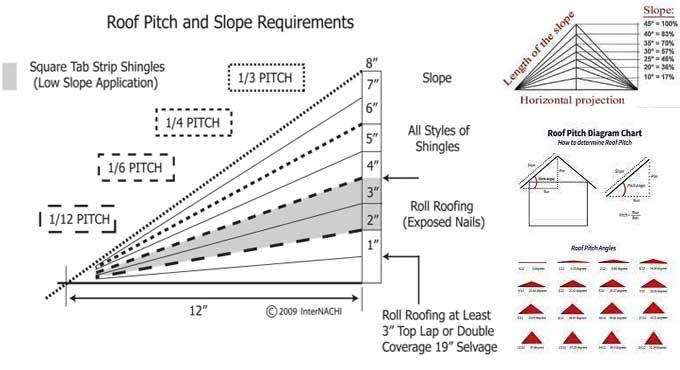
A 22.6-degree angle is considered a low-to-moderate slope. It is not flat, but it is also not steep.
- Flat Roofs: 0/12 to 2/12 (0°–9.5°)
- Low Slope: 3/12 to 4/12 (14°–18.4°)
- Conventional Slope: 5/12 to 9/12 (22.6°–36.9°)
- Steep Slope: 10/12 and above (39.8°+)
As you can see, a 5/12 pitch sits comfortably at the lower end of the “conventional” category. It is steep enough to shed water effectively but gentle enough to walk on with relative safety during maintenance.
Is a 5/12 Roof Pitch Good for Your Home?
Choosing a roof pitch is not just about aesthetics; it impacts functionality, cost, and longevity. Here is a breakdown of the pros and cons specific to a 5/12 slope.
Advantages of a 5/12 Pitch
- Cost-Effective Construction: Because the slope is moderate, it requires less structural support than steeper roofs. Framing is simpler, and workers can install shingles more quickly and safely, reducing labor costs.
- Walkability: Safety is a major concern for homeowners who need to clean gutters or inspect chimneys. A 22.6-degree angle is generally considered safe to walk on with proper footwear, unlike steeper pitches which require harnesses and scaffolding.
- Material Versatility: Most standard roofing materials, including asphalt shingles, metal panels, and clay tiles, are approved for use on a 5/12 pitch. You are not limited to specialized membrane systems required for flat roofs.
- Attic Space: While not as spacious as a 9/12 or 12/12 pitch, a 5/12 roof still provides usable attic space for storage or HVAC equipment, unlike low-slope roofs which often leave little room above the ceiling joists.
Disadvantages to Consider
- Water Drainage: While adequate for most climates, a 5/12 pitch does not shed water as rapidly as steeper roofs. In areas with heavy snowfall, snow may accumulate rather than slide off, potentially leading to ice dams if insulation and ventilation are not properly managed.
- Aesthetic Limitations: For certain architectural styles, such as Victorian or Tudor, a 5/12 pitch may appear too flat and lack the dramatic silhouette associated with those designs.
- Debris Accumulation: Leaves and pine needles are more likely to stick to a moderate slope compared to a steep one, requiring more frequent gutter cleaning.
| Feature | 5/12 Pitch (22.6°) | 8/12 Pitch (33.7°) |
|---|---|---|
| Walkability | Easy/Moderate | Difficult/Dangerous |
| Material Cost | Lower | Higher (more surface area) |
| Snow Shedding | Moderate | Excellent |
| Attic Volume | Moderate | High |
| Wind Resistance | Good | Better (less uplift surface) |
How to Measure Your Roof Pitch Accurately
If you are unsure whether your existing roof is a 5/12 pitch, you can verify it with a simple DIY test. You will need a 12-inch level and a tape measure.
- Safety First: Ensure you are on a stable ladder or securely on the roof. Never attempt this in wet or windy conditions.
- Place the Level: Hold the level horizontally against the bottom edge of a rafter or on the roof surface itself. Ensure the bubble is centered, indicating it is perfectly level.
- Measure the Rise: At the 12-inch mark on the level, measure the vertical distance from the bottom of the level to the roof surface.
- Read the Result: If the vertical distance is exactly 5 inches, you have a 5/12 pitch. If it is 4 inches, it is a 4/12 pitch, and so on.
For more detailed technical definitions on roof framing, you can refer to general construction standards outlined on Wikipedia’s Roof page.
Frequently Asked Questions (FAQ)
1. Can I install solar panels on a 5/12 pitch roof?
Yes, absolutely. A 5/12 pitch (22.6 degrees) is actually quite close to the optimal tilt angle for solar panels in many parts of the United States, which typically ranges between 20 and 35 degrees depending on latitude. This means you may not even need expensive tilting mounts, allowing for a flush, sleek installation that maximizes energy production.
2. What is the minimum pitch for asphalt shingles?
Most manufacturers require a minimum pitch of 2/12 or 4/12 for standard asphalt shingles, depending on the underlayment used. A 5/12 pitch is well above this minimum threshold, making it an excellent choice for asphalt shingles without needing special adhesive strips or double-layer underlayment required for lower slopes.
3. Does a 5/12 roof handle snow well?
It handles moderate snow well, but it is not ideal for regions with extremely heavy, wet snowfall. On a 22.6-degree slope, snow may stick rather than slide. If you live in a high-snow area, ensure your roof structure is rated for the additional load, and consider installing heat cables to prevent ice dams at the eaves.
4. How much more material do I need for a 5/12 roof compared to a flat roof?
Because of the slope, the surface area of a 5/12 roof is greater than the footprint of the house. Specifically, the multiplier for a 5/12 pitch is approximately 1.083. This means you need about 8.3% more roofing material than the square footage of your floor plan. For example, a 1,000 sq. ft. floor plan would require roughly 1,083 sq. ft. of roofing material.
5. Is a 5/12 pitch suitable for metal roofing?
Yes, metal roofing performs exceptionally well on a 5/12 pitch. Metal panels are smooth and shed water efficiently, even at lower slopes. In fact, standing seam metal roofs can often be installed on pitches as low as 1/12, so a 5/12 pitch provides a significant safety margin for water tightness and durability.
Conclusion
Understanding what is the angle of a 5 12 pitch roof empowers you to make smarter decisions about your home improvement projects. At 22.6 degrees, this pitch offers a sweet spot between affordability, safety, and functionality. It is steep enough to protect your home from water damage and compatible with almost all roofing materials, yet gentle enough to keep construction costs down and maintenance accessible.
Whether you are building a new home, replacing an old roof, or installing solar panels, a 5/12 pitch is a reliable, time-tested choice for modern American housing.
Found this guide helpful? Share it with your friends on Facebook or Pinterest who might be planning their next roofing project!
Leave a Reply