Planning a roof replacement or repair can feel overwhelming, especially when contractors start throwing around industry jargon that doesn’t quite make sense to the average homeowner. You might find yourself staring at a quote and wondering, “How many square feet are in a square of roofing?” It is a simple question with a critical answer that directly impacts your budget and material orders.
Understanding this basic unit of measurement is the first step toward taking control of your home improvement project. In this guide, we will break down the math, explain why this unit exists, and show you how to calculate your needs accurately so you never overpay or under-order again.
What Is a “Square” in Roofing Terminology?
If you have never worked in construction, the term “square” can be misleading. In everyday language, a square is a geometric shape. However, in the roofing industry, it is a specific unit of area used to simplify calculations for large surfaces.
A roofing square is equal to 100 square feet.
This means that if your roof has an area of 2,500 square feet, it is considered a 25-square roof. This standardization helps contractors, suppliers, and manufacturers communicate efficiently. Instead of saying, “I need enough shingles to cover 1,850 square feet,” a pro will simply say, “I need materials for 18.5 squares.”
Why Do Roofers Use Squares?
The primary reason is simplicity and speed. Roofs are large, and dealing with thousands of individual square feet can lead to calculation errors during quick estimates. By grouping every 100 square feet into one “square,” the numbers become more manageable.
- Easier Material Ordering: Shingles and underlayment are often sold by the square or in bundles that equate to a fraction of a square.
- Standardized Pricing: Most contractors quote prices per square (e.g., $350 per square), making it easier for homeowners to compare bids.
- Reduced Error: It minimizes the risk of misplacing zeros when calculating large areas.
How to Calculate Your Roof’s Square Footage
Before you can determine how many squares you need, you must accurately measure your roof’s total square footage. While it might seem tempting to just use your home’s floor plan, this method is often inaccurate because roofs extend beyond the walls (overhangs) and have complex pitches.
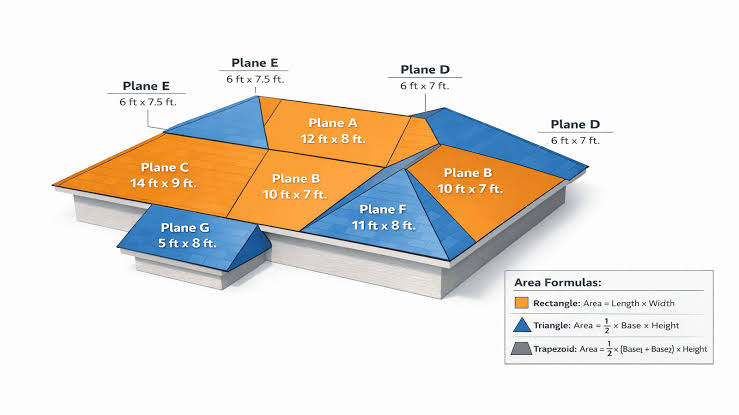
Step 1: Measure Each Plane
Break your roof down into individual rectangular planes. For each section:
- Measure the length from ridge to eave (or edge to edge).
- Measure the width along the eave.
- Multiply length by width to get the area of that plane.
Example: If one section is 40 feet long and 20 feet wide, the area is 800 square feet.
Step 2: Account for Overhangs
Do not forget the eaves and rakes. Measure any overhanging sections separately and add them to your total. Even a small 6-inch overhang can add significant square footage across the perimeter of a large home.
Step 3: Sum the Areas
Add the square footage of all planes together to get your total gross square footage.
Step 4: Convert to Squares
Divide your total square footage by 100.
Formula: Total Square Feet ÷ 100 = Number of Squares
Example: 2,400 sq ft ÷ 100 = 24 Squares.
The Critical Factor: Roof Pitch and Waste
Knowing the flat footprint of your roof is not enough. The steepness of your roof, known as the pitch, dramatically affects the actual surface area. A steep roof has more surface area than a flat roof covering the same floor space.
Understanding Roof Pitch
Roof pitch is expressed as a ratio of vertical rise to horizontal run (e.g., 6/12). This means for every 12 inches you go horizontally, the roof rises 6 inches vertically.
To get the true surface area, you must apply a pitch multiplier. You can find these multipliers in standard roofing charts or use the Pythagorean theorem.
| Roof Pitch | Multiplier | Impact on Area |
|---|---|---|
| 4/12 | 1.054 | +5.4% |
| 6/12 | 1.118 | +11.8% |
| 8/12 | 1.202 | +20.2% |
| 12/12 | 1.414 | +41.4% |
Note: For detailed mathematical definitions of geometric slopes, you can refer to general resources on Wikipedia.
Calculating Waste Factor
You cannot buy exactly the amount of material needed for the exact square footage. Cutting shingles to fit valleys, hips, and ridges creates waste. Additionally, mistakes happen.
- Simple Gable Roof: Add 10% waste factor.
- Complex Roof (Multiple Valleys/Hips): Add 15–20% waste factor.
Final Calculation Example:
- Flat Area: 2,000 sq ft (20 Squares)
- Pitch Adjustment (6/12 pitch): 2,000 x 1.118 = 2,236 sq ft
- Waste Factor (15%): 2,236 x 1.15 = 2,571 sq ft
- Total Squares Needed: 2,571 ÷ 100 = 25.71 Squares (Round up to 26 Squares)
Materials Per Square: What Do You Actually Buy?
Once you know your square count, you need to translate that into bundles of shingles or rolls of underlayment. This varies by material type, but here are the industry standards for asphalt shingles, the most common roofing material in the US.
Asphalt Shingles
- Bundles per Square: Typically 3 bundles make 1 square.
- Shingles per Bundle: Usually contains 20–26 shingles, depending on the brand and style.
- Weight: A square of asphalt shingles weighs between 200 to 350 pounds.
Other Materials
- Wood Shakes: Often require 4 bundles per square due to thicker spacing.
- Metal Roofing: Sold by linear feet or panels, not typically by the “square” in the same way, though coverage is still calculated in square feet.
- Slate/Tile: Much heavier and often requires specialized structural support. Coverage varies significantly by tile size.
Pro Tip: Always check the manufacturer’s specifications on the bundle wrapper. Some architectural or premium shingles may require 4 or even 5 bundles to cover one square due to their thickness and exposure requirements.
Common Mistakes When Estimating Roof Squares
Even with the right formula, homeowners and DIYers often stumble. Here are the most frequent errors to avoid:
- Ignoring the Chimneys and Vents: While small, these penetrations require flashing and extra cutting. While they don’t add much area, they increase labor and waste.
- Using Floor Plan Square Footage: Your home’s living area is not your roof area. A two-story house with a 2,000 sq ft footprint might only have a 1,000 sq ft roof if it’s a simple gable, or much more if it’s complex. Never assume 1:1 correlation.
- Forgetting Dormers: Dormers add significant surface area. Measure each dormer face separately and add it to the total.
- Rounding Down: Always round up when ordering materials. Running short mid-project means delaying work while waiting for a new delivery, which risks weather exposure to the open roof deck.
FAQ Section
Q1: Does a square of roofing always equal 100 square feet?
A: Yes. In the US roofing industry, a “square” is universally defined as 100 square feet. This standard applies regardless of the roofing material (asphalt, metal, tile, etc.).
Q2: How many bundles of shingles do I need for one square?
A: For standard 3-tab asphalt shingles, you typically need 3 bundles to cover one square (100 sq ft). For thicker architectural shingles, check the label, as some may require 4 bundles per square.
Q3: Can I measure my roof from the ground?
A: You can get a rough estimate using ground measurements and photos, but it is not accurate for ordering materials. Factors like pitch, overhangs, and complex angles are hard to judge from the ground. For precise quotes, professionals use laser measures or drone technology.
Q4: Why do contractors charge per square instead of per square foot?
A: Charging per square simplifies the billing process. It allows for quicker mental math during negotiations and aligns with how materials are packaged and shipped. It also helps buffer minor measurement discrepancies without renegotiating every single foot.
Q5: How much does a square of roofing cost?
A: Costs vary widely based on material and location. As of recent trends, asphalt shingles might range from $350 to $550 per square installed, while metal or slate can exceed $1,000 per square. Always get multiple local quotes for accurate pricing.
Q6: Is there a difference between a “square” and a “bundle”?
A: Yes. A square is a unit of area (100 sq ft). A bundle is a physical package of shingles. It usually takes 3 bundles to make one square, but this depends on the shingle type.
Conclusion
Understanding how many square feet are in a square of roofing is fundamental to any successful roofing project. Remember, one square equals 100 square feet. By accurately measuring your roof’s planes, adjusting for pitch, and adding a waste factor, you can order the right amount of material and avoid costly delays.
Whether you are hiring a professional or tackling a small shed roof yourself, this knowledge empowers you to speak the same language as contractors and verify quotes with confidence. Don’t let measurement errors eat into your budget.
Found this guide helpful? Share it with friends or family who are planning home improvements, and bookmark it for your next renovation project! Accurate measurements save money—start calculating today.
Leave a Reply