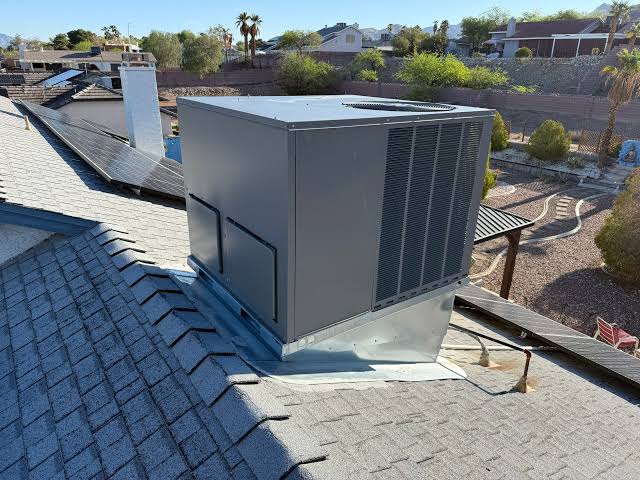
Have you ever driven through the sprawling suburbs of Nevada and noticed something peculiar? Instead of the familiar humming boxes tucked away in backyards, you see massive units perched precariously on top of homes and businesses. It’s a striking visual that defines the skyline here. If you’ve found yourself asking why are air conditioners on the roof in Las Vegas, you aren’t alone; it is one of the most common questions for newcomers to the Silver State.
The short answer is a combination of extreme heat management, space optimization, and specific architectural trends. But to truly understand this phenomenon, we need to dig deeper into the engineering logic that keeps Las Vegas cool when temperatures soar above 110°F (43°C).
The Space-Saving Advantage in Dense Urban Planning
One of the primary drivers for rooftop installations is simply real estate. In many parts of Las Vegas, particularly in newer master-planned communities like Summerlin or Henderson, lot sizes can be surprisingly compact relative to the square footage of the house.
Maximizing Yard Utility
In traditional climates, an outdoor condenser unit sits on a concrete slab in the backyard. However, in Las Vegas:
- Backyards are premium spaces: Residents want to use their limited outdoor area for pools, patios, and entertainment zones, not industrial machinery.
- Side yards are narrow: Many modern homes have zero-lot-line designs, leaving no room on the sides for equipment.
By moving the HVAC system to the roof, homeowners reclaim every inch of ground-level space. This is especially crucial for commercial buildings on the Strip, where every square foot of ground space is valuable for retail or pedestrian traffic.
Combating the Extreme Desert Heat
You might think placing an AC unit in the direct sun is counterintuitive. After all, doesn’t heat make ACs work harder? Yes, but the engineering solution lies in airflow and heat dissipation, which are often more efficient at higher elevations.
Better Air Circulation
Ground-level units often struggle with “short-cycling” or recirculating their own hot exhaust air if they are boxed in by fences, shrubs, or walls. On the roof:
- Unobstructed Airflow: There are no fences or dense landscaping to block air intake.
- Wind Assistance: Even slight breezes at roof level help dissipate the heat generated by the condenser coils more effectively than stagnant air at ground level.
Thermal Separation
While the roof surface gets hot, the unit itself is elevated. This separation prevents the ground-radiated heat (from asphalt or concrete) from compounding the thermal load on the machine. Modern rooftop units (RTUs) are also built with higher-grade insulation and materials designed to withstand direct UV exposure, unlike some residential split-system condensers.
Architectural Trends: The Rise of Flat Roofs
If you look closely, you’ll notice that rooftop ACs are predominantly found on homes with flat or low-slope roofs. This is a distinct architectural style in the Southwest, influenced by:
- Mid-Century Modernism: A style popularized in Las Vegas during its boom years.
- Pueblo Revival: Drawing inspiration from traditional adobe structures.
- Commercial Practicality: Flat roofs are cheaper to build and easier to maintain for large structures.
Sloped, shingled roofs (common in the Midwest or East Coast) make rooftop installation difficult and prone to leaks. Flat roofs, typically made of torch-down asphalt or foam coating, provide a stable, waterproof platform perfect for heavy HVAC equipment.
Note: Not all Las Vegas homes have rooftop ACs. Traditional pitched-roof neighborhoods still use ground-mounted split systems. The rooftop trend is specific to flat-roof architecture.
Maintenance and Accessibility: A Double-Edged Sword
From an technician’s perspective, rooftop units offer unique advantages and challenges. Understanding this helps explain why builders continue to choose this method.
Pros for Technicians
- No Obstacles: Techs don’t need to navigate around backyard dogs, kids’ toys, or intricate landscaping.
- Centralized Location: For large commercial buildings, having all units on the roof allows for easier centralized monitoring and maintenance routes.
Cons for Homeowners
- Leak Risks: The biggest concern is water intrusion. Every penetration in the roof is a potential leak point. Proper flashing and sealant are critical.
- Service Difficulty: Technicians require ladders or lifts, which can increase service call costs slightly compared to walking out the back door.
To mitigate leak risks, reputable HVAC companies in Las Vegas follow strict protocols. They use reinforced curbs and high-quality elastomeric coatings to ensure the roof remains watertight around the unit base.
Energy Efficiency and Noise Reduction
Beyond space and heat, there are comfort factors involved.
Quieter Operations
An AC compressor is noisy. When placed on the ground near a patio, it can disrupt outdoor conversations. On the roof:
- Distance: The sound is further away from living areas.
- Directionality: Noise is directed upward and outward, rather than into a fenced backyard enclosure.
Efficiency Ratings
Modern rooftop packaged units often come with high SEER (Seasonal Energy Efficiency Ratio) ratings. Because they are self-contained systems, they eliminate the energy loss associated with long refrigerant lines that run from a ground condenser to an attic air handler. Shorter duct runs from the roof down into the home can sometimes improve overall system efficiency, provided the ductwork is well-insulated against the attic heat.
Comparison: Rooftop vs. Ground-Mounted AC in Las Vegas
| Feature | Rooftop Unit (RTU) | Ground-Mounted Split System |
|---|---|---|
| Space Usage | Saves yard space | Uses backyard/side yard |
| Heat Exposure | Direct sun, but better airflow | Shaded options available |
| Noise Level | Quiet at ground level | Audible in backyard |
| Maintenance Access | Requires ladder/roof access | Easy ground access |
| Leak Risk | Higher (roof penetration) | None (ground slab) |
| Best For | Flat roofs, small lots | Pitched roofs, large lots |
External Authority Reference
For those interested in the broader history of air conditioning technology and its impact on urban development, you can explore detailed historical context on Wikipedia’s page on Air Conditioning. This resource provides insight into how HVAC evolution has shaped modern architecture, including the shift toward integrated rooftop systems in commercial and residential sectors.
FAQ Section
1. Do rooftop ACs break down faster in Las Vegas heat?
Not necessarily. While they are exposed to more sun, they are engineered for it. Most rooftop units have heavy-duty compressors and coils designed for commercial use. With regular maintenance—such as cleaning coils twice a year—they can last just as long as ground units, typically 15–20 years.
2. Can I install a rooftop AC on my existing pitched roof?
It is highly discouraged. Installing a heavy unit on a shingled, sloped roof requires significant structural reinforcement and creates a high risk of leaks. It is generally only feasible on flat or very low-slope roofs with proper waterproofing membranes.
3. Is it more expensive to repair a rooftop AC?
It can be slightly more expensive. The labor cost may be higher because technicians need to set up ladders or safety harnesses. Additionally, if the unit needs replacement, crane services might be required to lift the new unit onto the roof, adding to the installation cost.
4. How do I prevent leaks around my rooftop AC unit?
Regular inspections are key. Ensure your HVAC provider checks the “curb” (the frame the unit sits on) and the flashing annually. Look for cracks in the sealant or pooling water around the base. Applying a fresh coat of elastomeric roof coating every few years can also seal minor gaps.
5. Why don’t I see rooftop ACs in older Las Vegas neighborhoods?
Older neighborhoods (built before the 1990s) often feature pitched tile or shingle roofs, which are incompatible with rooftop units. These homes typically use traditional split systems with ground-mounted condensers. The rooftop trend coincided with the rise of flat-roofed, mid-century modern, and contemporary architectural styles in newer developments.
Conclusion
So, why are air conditioners on the roof in Las Vegas? It’s a smart adaptation to a unique environment. By moving these essential machines upstairs, residents gain valuable backyard space, reduce noise pollution, and leverage better airflow for cooling efficiency. While it requires diligent maintenance to prevent leaks, the trade-off is a cooler home and a more usable outdoor living area.
If you’re considering a home in Las Vegas or just curious about the skyline, now you know the logic behind the view. It’s not just an aesthetic choice; it’s a functional necessity born from the desert climate.
Found this article helpful? Share it with your friends who are planning a move to Vegas or those who are just curious about desert architecture! Let’s keep the conversation going on social media.
Leave a Reply