If you are planning a roofing project or simply trying to understand the blueprints for your new home, you have likely encountered the term “8/12 pitch.” It sounds technical, but it fundamentally describes how steep your roof is. Many homeowners struggle to visualize this ratio in real-world terms, leading to confusion when buying materials or hiring contractors. So, what is the angle of an 8 12 pitch roof? The short answer is approximately 33.69 degrees, but understanding why that number matters is crucial for your project’s success.
In this guide, we will break down the mathematics behind roof pitches, explain the practical implications of an 8/12 slope, and help you determine if this steep design is right for your building needs. Whether you are a DIY enthusiast or a homeowner verifying contractor quotes, this article provides the clarity you need.
Understanding the Basics: How Roof Pitch Works
Before we dive into the specific angle, it is essential to understand how roof pitch is measured in the United States. Unlike many other countries that use degrees or percentages, the US construction industry primarily uses a ratio based on inches.
The Rise over Run Ratio
Roof pitch is expressed as a fraction: Rise / Run.
- The Rise: The vertical height the roof gains.
- The Run: The horizontal distance covered.
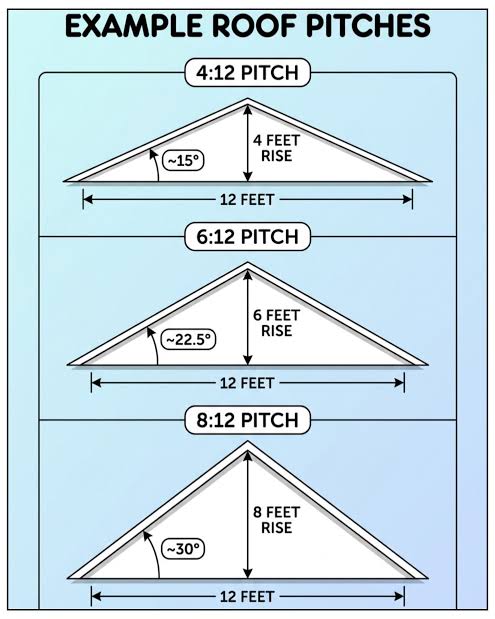
By standard convention, the “run” is always fixed at 12 inches. Therefore, an 8/12 pitch means that for every 12 inches you move horizontally across the roof, the roof rises 8 inches vertically.
This creates a triangle. To find the angle, we use basic trigonometry. Specifically, we use the arctangent function (tan⁻¹).
Angle=tan−1(RunRise)
Angle=tan−1(128)
Angle=tan−1(0.6667)≈33.69∘
So, when you ask, what is the angle of an 8 12 pitch roof, the precise mathematical answer is 33.69 degrees. In practical construction terms, this is often rounded to 34 degrees.
Why Does an 8/12 Pitch Matter?
An 8/12 roof is considered a steep-slope roof. In the roofing industry, slopes are generally categorized as follows:
- Low Slope: 0/12 to 3/12
- Conventional Slope: 4/12 to 9/12
- Steep Slope: 10/12 and above
However, an 8/12 pitch sits right on the border of “conventional” and “steep.” It is significantly steeper than the most common residential pitch (which is typically 4/12 or 6/12). This distinction has major implications for safety, material costs, and aesthetics.
Visual Impact and Curb Appeal
One of the primary reasons homeowners choose an 8/12 pitch is aesthetic. A steeper roof adds vertical volume to a home, making it appear larger and more imposing. This style is frequently seen in:
- Colonial Revival Homes
- Tudor Styles
- Modern Farmhouses
The sharp angle creates dramatic shadow lines and allows for higher ceiling heights in attics or upper floors. If you are aiming for a grand, traditional look, an 8/12 pitch is an excellent choice.
Practical Implications of a 33.69-Degree Roof
Knowing the angle is just the first step. You must understand how this specific slope affects the construction process and long-term maintenance.
1. Safety and Accessibility
This is the most critical factor. A 33.69-degree angle is too steep for safe walking without proper equipment.
- Standard Walking Limit: Most professional roofers consider anything above a 6/12 pitch (26.5 degrees) difficult to walk on.
- Equipment Required: For an 8/12 pitch, contractors must use roof jacks, toe boards, and harnesses. Simple ladders may not suffice for edge work.
- DIY Warning: If you are considering a DIY repair, an 8/12 roof is generally not recommended for amateurs. The risk of slipping is high, and the margin for error is low.
2. Material Costs and Labor
Because of the safety requirements and the increased surface area, an 8/12 roof is more expensive to build than a flatter one.
| Feature | 4/12 Pitch (Common) | 8/12 Pitch (Steep) |
|---|---|---|
| Walkability | Easy to walk on | Requires harnesses/jacks |
| Material Usage | Standard | ~15-20% More Surface Area |
| Labor Cost | Standard Rate | Higher (Hazard Pay/Specialists) |
| Installation Speed | Fast | Slower due to safety setup |
According to industry standards, labor costs for steep roofs can be 20% to 50% higher than conventional roofs. This is because crews work slower to ensure safety, and insurance premiums for roofing companies are higher for steep-slope projects.
3. Weather Performance
An 8/12 pitch excels in shedding water and snow.
- Snow Load: In regions with heavy snowfall (like the Northeast US or the Rockies), a 33.69-degree angle helps snow slide off before it accumulates to dangerous weights. This reduces the risk of structural collapse.
- Water Drainage: Rainwater drains rapidly, minimizing the chance of leaks caused by standing water or ice dams.
However, there is a downside. In high-wind areas, a steeper roof presents a larger vertical surface area to the wind, which can increase uplift pressure. Proper anchoring and adherence to local building codes are vital.
How to Measure Your Roof Pitch Accurately
If you are unsure if your roof is truly 8/12, you can verify it using a simple method. You will need a level (at least 12 inches long) and a tape measure.
- Go to the Attic: It is safer to measure from inside the attic than climbing onto the roof.
- Place the Level: Hold the level horizontally against the bottom of a rafter. Ensure the bubble is centered.
- Measure the Rise: At the 12-inch mark on the level, measure the vertical distance from the bottom of the level to the bottom of the rafter.
- Calculate: If that vertical distance is 8 inches, you have an 8/12 pitch.
Note: Always wear protective gear when entering an attic, including a mask for insulation particles.
For external measurements, professionals use a digital inclinometer or a smartphone app designed for construction. These tools provide instant degree readings, confirming the 33.69-degree angle.
Comparing 8/12 to Other Common Pitches
To put the 8/12 pitch in perspective, let’s compare it to other common residential angles.
- 4/12 Pitch (18.43°): Very common. Easy to walk on. Cheaper to build. Poor snow shedding.
- 6/12 Pitch (26.57°): The “standard” for many modern homes. Good balance of cost and drainage.
- 8/12 Pitch (33.69°): Steep. Dramatic look. Excellent drainage. Higher cost.
- 12/12 Pitch (45°): Very steep. Often found in A-frames. Extremely difficult to maintain.
As you can see, moving from a 6/12 to an 8/12 pitch increases the angle by roughly 7 degrees. While this seems small, it significantly changes the dynamics of construction and safety.
Expert Insight on Structural Integrity
When building an 8/12 roof, the structural load changes. The rafters must support not only the weight of the roofing materials but also the lateral thrust generated by the steep angle.
According to general engineering principles outlined in resources like Wikipedia’s entry on Roof Pitch, steeper pitches require stronger ties or collar beams to prevent the walls from spreading outward under the weight of the roof. If you are retrofitting an existing structure to an 8/12 pitch, consult a structural engineer to ensure your wall plates can handle the increased horizontal force.
FAQ Section
1. Is an 8/12 roof pitch too steep for solar panels?
Not necessarily. Most solar panels are designed to work efficiently on pitches between 10 and 40 degrees. An 8/12 pitch (33.69°) is actually quite good for solar production in many US latitudes. However, installation is more complex and costly due to the steep angle. Specialized mounting racks and safety protocols are required.
2. Can I walk on an 8/12 pitch roof?
It is highly discouraged. While a professional roofer with proper fall protection (harnesses, anchor points) can work on it, it is not safe for casual walking. For a homeowner, attempting to walk on a 33.69-degree slope without training and equipment poses a severe risk of injury.
3. Does an 8/12 pitch require special shingles?
No, standard asphalt shingles can be used on an 8/12 pitch. However, because the roof is steeper, wind uplift is a greater concern. You may need to use additional adhesive or nail patterns as specified by the shingle manufacturer for steep-slope applications. Always check the warranty requirements of your specific roofing material.
4. How much more does an 8/12 roof cost compared to a 4/12 roof?
You can expect to pay 15% to 30% more for an 8/12 roof compared to a 4/12 roof. This increase comes from two sources: increased material usage (more surface area) and higher labor costs (slower work pace and safety equipment).
5. What is the best roof pitch for heavy snow areas?
While an 8/12 pitch is excellent for snow, a 10/12 or 12/12 pitch is even better for shedding heavy snow loads. However, an 8/12 pitch is often the “sweet spot” where you get good snow shedding without the extreme costs and difficulties associated with very steep roofs like 12/12.
6. How do I convert 8/12 pitch to degrees manually?
Use a scientific calculator. Divide 8 by 12 to get 0.6667. Then, press the “inverse tangent” or “tan⁻¹” button. The result will be approximately 33.69 degrees.
Conclusion
Understanding what is the angle of an 8 12 pitch roof is about more than just knowing it is 33.69 degrees. It is about recognizing the trade-offs between aesthetic appeal, weather performance, and construction cost.
An 8/12 pitch offers a striking, traditional look and superior water drainage, making it ideal for snowy climates and historic-style homes. However, it demands respect regarding safety and budget. It requires professional installation, specialized safety gear, and potentially reinforced structural supports.
If you are drawn to the dramatic silhouette of a steep roof, an 8/12 pitch is a fantastic choice. Just ensure you hire experienced contractors who are insured for steep-slope work.
Did you find this guide helpful? Share this article with your friends or on social media to help others navigate their roofing projects with confidence!
Leave a Reply