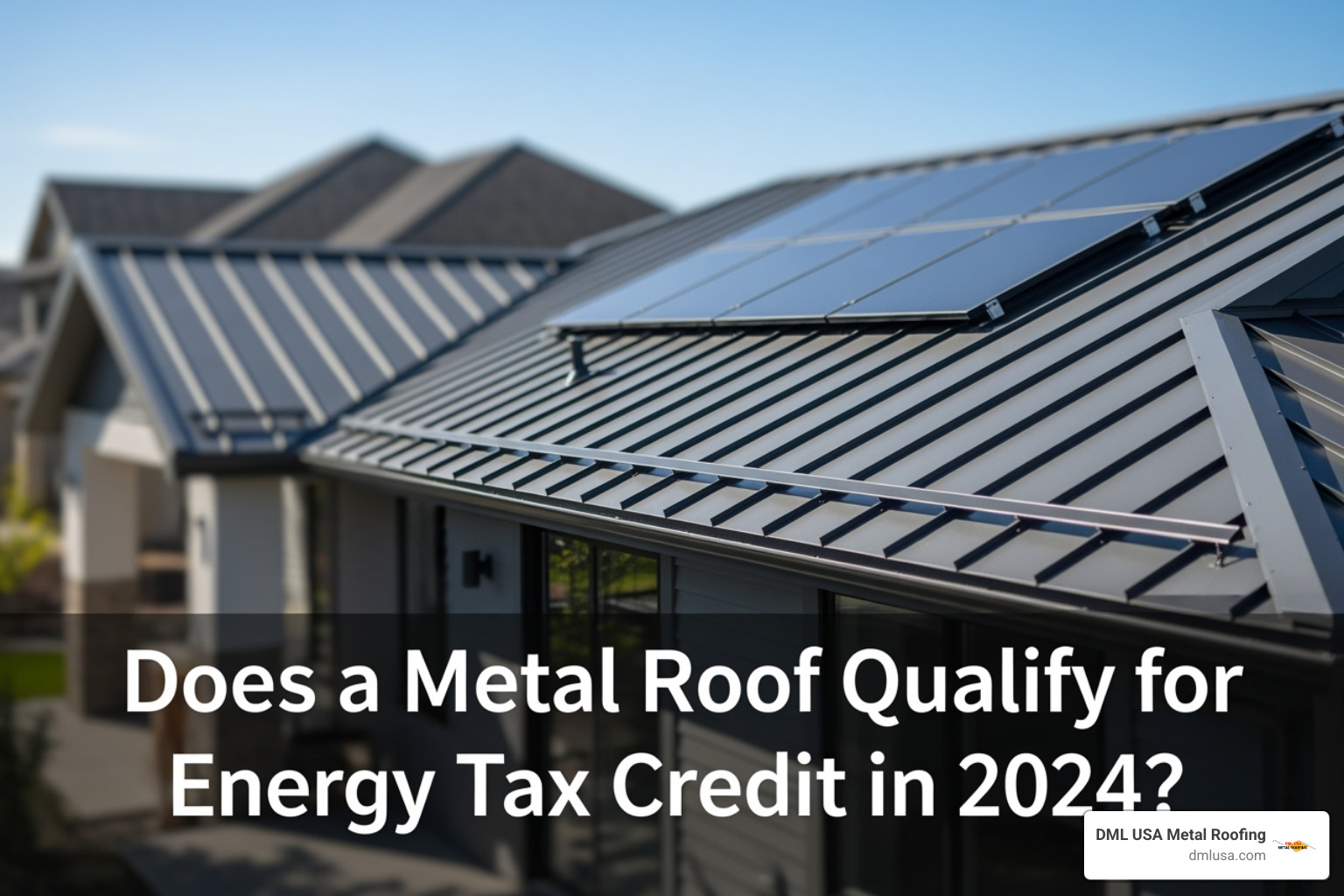
Replacing a roof is one of the most significant investments a homeowner can make. It is stressful, expensive, and often unexpected. If you are currently planning a replacement or dealing with storm damage, you are likely looking for every possible way to offset the cost. A common question that arises during this process is: Does a new roof qualify for energy tax credit 2024?
The short answer is: It depends entirely on the materials you choose.
A standard asphalt shingle roof generally does not qualify. However, if you install specific energy-efficient roofing products that meet strict federal standards, you may be eligible for a valuable tax credit. In this guide, we will break down exactly what qualifies, how much money you can save, and the steps you need to take to ensure you don’t miss out on this financial benefit.
Understanding the 2024 Energy Efficient Home Improvement Credit
To understand whether your new roof qualifies, we first need to look at the legislation behind it. The credit you are likely referring to is part of the Inflation Reduction Act, which extended and modified the Nonbusiness Energy Property Credit (often called the “Energy Efficient Home Improvement Credit”).
For the 2024 tax year, this credit allows homeowners to claim 30% of the cost of qualifying energy-efficient improvements, up to a maximum annual limit.
Key Changes for 2024
Prior to recent updates, the limits were lower and the rules were more complex. For 2024, the IRS has streamlined the process, but the criteria for what constitutes an “energy-efficient” roof remain strict. The goal of the government is not just to reward home improvement, but to specifically incentivize reductions in household energy consumption.
According to the Internal Revenue Service, the credit is designed to help taxpayers reduce their energy bills while lowering the national carbon footprint. This context is crucial because it explains why a basic cosmetic roof upgrade does not qualify—the primary intent must be energy efficiency.
What Roofing Materials Actually Qualify?
This is the most critical section for your wallet. Many contractors may vaguely mention “tax credits,” but you need to verify the specific product certification.
1. Metal Roofs with Pigmented Coatings
Metal roofs are highly durable and reflective. To qualify for the 2024 tax credit, a metal roof must have pigmented coatings that meet the Energy Star program requirements for initial solar reflectance and thermal emittance.
- Why it works: These coatings reflect solar heat away from your home, reducing the load on your air conditioning system.
- Requirement: You must obtain the manufacturer’s certification statement confirming the product meets Energy Star criteria.
2. Asphalt Shingles with Cooling Granules
Not all asphalt shingles are created equal. Standard black shingles absorb heat. However, certain premium asphalt shingles are manufactured with special cooling granules that reflect more sunlight.
- The Catch: Only specific lines from major manufacturers (such as GAF, CertainTeed, or Owens Corning) carry the necessary Energy Star rating.
- Verification: Do not assume “cool color” means qualified. Look for the official Energy Star label on the product packaging or spec sheet.
3. Tile Roofs (Clay and Concrete)
Similar to metal, clay and concrete tiles can qualify if they are designed to meet the solar reflectance index (SRI) standards set by the EPA’s Energy Star program. These are popular in the Southwest US for their natural thermal mass and reflective properties.
Products That Do NOT Qualify
It is equally important to know what is excluded to avoid disappointment:
- Standard wood shakes or shingles.
- Basic slate roofing (unless specially coated/certified, which is rare).
- Standard dark-colored asphalt shingles without reflective technology.
- Labor costs alone (the credit applies to the material cost, though installation is often bundled in the receipt; check current IRS guidance on bundled pricing).
How Much Can You Save? The Financial Breakdown
Understanding the potential savings helps justify the upfront cost of premium materials. For the 2024 tax year, the limits are generous compared to previous years.
| Expense Category | Credit Rate | Annual Limit |
|---|---|---|
| Qualified Roofing Materials | 30% of cost | Up to $1,200* |
| Insulation & Air Sealing | 30% of cost | Up to $1,200* |
| Total Annual Cap | N/A | $1,200 |
*Note: The $1,200 cap is an aggregate limit for all “building envelope” components, including windows, doors, insulation, and roofs. You cannot claim $1,200 for the roof AND another $1,200 for windows in the same year. The total combined credit for these items cannot exceed $1,200.
Example Calculation
Let’s say you spend $4,000 on qualified Energy Star metal roofing panels.
- Calculation: $4,000 x 0.30 = $1,200.
- Since this hits the annual cap, your maximum credit is $1,200.
If you spend $2,000 on qualified shingles:
- Calculation: $2,000 x 0.30 = $600.
- Your credit is $600. You still have $600 of “room” left in your annual cap for other improvements like attic insulation.
Step-by-Step Guide to Claiming the Credit
Claiming the credit is not automatic. You must follow specific procedures during and after installation.
Step 1: Verify Eligibility Before Purchase
Do not wait until the invoice is paid. Ask your contractor for the Manufacturer’s Certification Statement. This document proves the specific product batch meets Energy Star requirements. Without this paper trail, the IRS may deny your claim during an audit.
Step 2: Keep Detailed Records
Save the following documents in a dedicated folder (digital or physical):
- The itemized receipt showing the cost of materials separately from labor (if possible).
- The Manufacturer’s Certification Statement.
- Proof of payment (credit card statement or cancelled check).
- Date of installation.
Step 3: File IRS Form 5695
When filing your 2024 federal tax return (in early 2025), you must complete IRS Form 5695 (Residential Energy Credits).
- Go to Part II of the form (“Energy Efficient Home Improvement Credit”).
- Enter the cost of your qualified roofing materials.
- Calculate 30% of that cost.
- Apply the annual limit ($1,200).
- Transfer the final credit amount to your Schedule 3 (Form 1040).
Step 4: Consult a Tax Professional
Tax laws are subject to change and individual circumstances vary. If your tax situation is complex, have a CPA review your Form 5695 before submission.
Common Misconceptions About Roofing Tax Credits
There is a lot of misinformation online. Let’s clear up the most frequent confusion points.
Myth 1: “Solar Panels are the same as a Solar Roof.”
- Fact: No. Solar panels fall under the Residential Clean Energy Credit, which has a separate 30% credit with no annual dollar limit. A standard energy-efficient roof falls under the Home Improvement Credit with the $1,200 cap. Do not mix these up.
Myth 2: “I can claim the credit for a repair.”
- Fact: Generally, no. The credit is for new installations or replacements. Patching a few shingles does not qualify. The entire roofing component (or a significant section acting as a new installation) must be replaced with qualified materials.
Myth 3: “The credit is a refund.”
- Fact: It is a non-refundable tax credit. This means it can reduce your tax liability to zero, but if the credit is larger than the taxes you owe, you do not get the difference back in cash. However, unused portions generally do not carry over to the next year for this specific credit, so ensure you have enough tax liability to use it.
FAQ Section
1. Does a new roof qualify for energy tax credit 2024 if I live in a rental property?
No. This credit is strictly for primary residences owned by the taxpayer. Rental properties, second homes, and commercial buildings do not qualify for the Residential Energy Efficient Home Improvement Credit.
2. Can I claim the credit if I installed the roof myself (DIY)?
Yes, provided you purchase qualified materials that meet Energy Star standards. You must keep the receipts for the materials and the manufacturer’s certification. However, ensure local building codes allow DIY roofing, as improper installation can void warranties and insurance.
3. What if I already filed my 2023 taxes but forgot to claim a 2023 roof?
You can file an amended return using Form 1040-X. If your roof was installed in 2023, it falls under the previous year’s rules, which also offered a 30% credit but had different cumulative lifetime limits in prior years. For 2024 installations, stick to the current year’s filing.
4. Is there an income limit for claiming this credit?
Unlike some other green energy incentives, the Energy Efficient Home Improvement Credit does not have an income cap. High-income earners are eligible to claim the full credit, provided they have the tax liability to offset.
5. How long does it take to receive the refund?
The credit reduces the amount of tax you owe. If you are due a refund, the credit increases that refund amount. Processing times depend on the IRS, typically ranging from 21 days for e-filed returns to several months for paper filings.
Conclusion
So, does a new roof qualify for energy tax credit 2024? Yes, but only if you choose the right materials.
By opting for Energy Star-certified metal roofs, cool asphalt shingles, or reflective tiles, you can recoup up to $1,200 of your investment through federal tax credits. This not only lowers your immediate tax bill but also reduces your long-term energy costs through better heat reflection.
Don’t leave money on the table. Before you sign that contract with your roofer, ask for the Energy Star Certification for their proposed materials. It’s a small piece of paper that could save you hundreds of dollars.
Found this guide helpful? Share it with friends or family who are planning home improvements this year. Helping others save money is always a good deed!
Leave a Reply