Are you struggling with a metal roof that turns your attic into a sauna during summer or a freezer in winter? You are not alone; many homeowners look for cost-effective solutions to regulate temperature without replacing their entire roofing structure. Understanding the 1 inch foam insulation under metal roof pros and cons is crucial before you commit to this specific thickness, as it can make or break your home’s comfort and energy efficiency.
Why Consider 1-Inch Foam for Metal Roofs?
Metal roofs are durable and aesthetically pleasing, but they are also excellent conductors of heat. Without proper insulation, thermal transfer occurs rapidly. While thicker insulation (like R-30 or higher) is often recommended for extreme climates, 1-inch foam (typically closed-cell spray foam) offers a unique middle ground. It provides an air seal and a moisture barrier, which are critical for metal roofing systems.
However, is one inch enough? That depends on your climate zone, your existing ventilation, and your budget. Let’s dive deep into the specifics.
The Advantages: Why Homeowners Choose 1-Inch Foam
When evaluating the 1 inch foam insulation under metal roof pros and cons, the benefits often center around air sealing and moisture management rather than pure thermal resistance.
1. Superior Air Sealing Capabilities
Unlike fiberglass batts, which can leave gaps around rafters and nails, spray foam expands to fill every crevice. A 1-inch layer of closed-cell foam creates an airtight envelope. According to the U.S. Department of Energy, air leakage can account for up to 40% of a home’s heating and cooling costs. By sealing these leaks, even a thin layer of foam significantly reduces drafts.
2. Moisture and Condensation Barrier
One of the biggest enemies of metal roofs is condensation. When warm, moist air from inside your home hits the cold underside of the metal roof, water droplets form. This leads to rust, mold, and wood rot. Closed-cell foam has a low permeability rating, acting as a Class II vapor retarder. This means it stops moist indoor air from reaching the cold metal surface, effectively preventing condensation buildup.
3. Added Structural Rigidity
Closed-cell spray foam is dense and hardens after application. Applying a 1-inch layer can add slight structural integrity to the roof deck, helping it resist wind uplift. While it won’t replace structural engineering requirements, it is a beneficial side effect that fiberglass or cellulose cannot offer.
4. Cost-Effectiveness Compared to Thicker Layers
Spray foam is expensive. By limiting the application to 1 inch, you reduce material and labor costs significantly while still gaining the air-sealing and vapor-barrier benefits. For homeowners on a budget who already have some bulk insulation (like fiberglass) in the floor joists, adding 1 inch of foam to the roof deck is a strategic compromise.
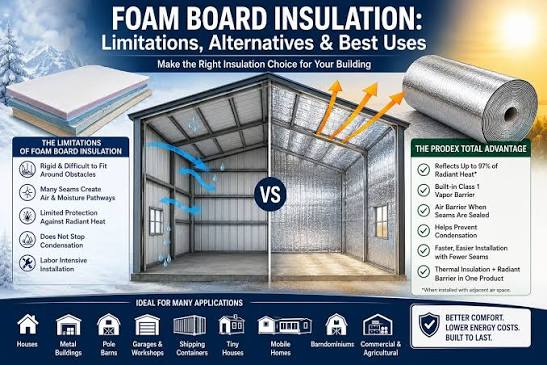
The Disadvantages: Risks and Limitations
No solution is perfect. To give you a balanced view of the 1 inch foam insulation under metal roof pros and cons, we must address the potential downsides.
1. Low R-Value per Inch
The primary drawback is thermal resistance. Closed-cell spray foam typically has an R-value of roughly R-6 to R-7 per inch. Therefore, a 1-inch layer only provides an R-value of roughly R-6 to R-7.
- Context: Most building codes in the US require roof insulation between R-30 and R-60, depending on the climate zone.
- Result: On its own, 1 inch of foam is insufficient to meet code requirements for thermal performance in most regions. It must be part of a hybrid system.
2. Risk of “Thermal Bridging”
If the foam is applied directly to the underside of the roof deck but does not cover the rafters completely, or if there are gaps, thermal bridging can occur. Heat will travel through the wooden rafters faster than through the insulated spaces, leading to uneven temperatures and potential ice damming in colder climates.
3. Installation Complexity and Professional Requirement
You cannot DIY this effectively. Spray foam requires specialized equipment, protective gear, and precise mixing ratios. Improper installation can lead to off-gassing issues or poor adhesion. Furthermore, if the foam is too thin in certain spots, it may not cure properly, leading to long-term durability issues.
4. Potential for Hidden Moisture Traps
If the 1-inch foam is applied over wet wood or if there is a leak in the metal roof above, the foam can trap that moisture against the wood. Since closed-cell foam is impermeable, the wood cannot dry out, accelerating rot. This makes pre-installation inspection of the roof deck critical.
Comparison: 1-Inch Foam vs. Traditional Insulation
To help you visualize where 1-inch foam stands, here is a quick comparison table.
| Feature | 1-Inch Closed-Cell Foam | Fiberglass Batts (R-19) | Cellulose Blown-In |
|---|---|---|---|
| R-Value | ~R-6.5 | ~R-19 | ~R-13 to R-15 |
| Air Sealing | Excellent | Poor | Moderate |
| Moisture Barrier | Yes (Vapor Retarder) | No | No (Can absorb moisture) |
| Installation | Professional Only | DIY Friendly | Professional Recommended |
| Cost | High per inch | Low | Moderate |
| Best Use Case | Air seal + Vapor barrier | Bulk thermal insulation | Retrofitting attics |
Note: For optimal performance, many experts recommend a “hybrid approach”: 1 inch of spray foam for air sealing/vapor control, topped with fiberglass or cellulose to reach the required total R-value.
Critical Considerations Before Installation
Before you hire a contractor, consider these technical factors to ensure success.
Climate Zone Matters
In warmer climates (Zone 1-3), 1 inch of foam might be sufficient to prevent condensation and provide moderate cooling benefits. However, in colder climates (Zone 5-8), relying solely on 1 inch of foam will lead to high energy bills. You must check your local building codes. For more detailed information on insulation standards, you can refer to the Wikipedia page on Building Insulation to understand global and regional variations.
Ventilation Strategy
There are two main approaches when insulating under a metal roof:
- Unvented Roof Assembly: The foam seals the roof deck completely. No airflow is needed between the foam and the metal. This is ideal for complex roof shapes.
- Vented Roof Assembly: An air gap is left above the foam or below the metal panels. If you use 1 inch of foam, ensure it does not block soffit vents if you are maintaining a vented attic space.
Type of Foam
Ensure you are using closed-cell foam, not open-cell. Open-cell foam is permeable to moisture and has a lower R-value (approx R-3.5 per inch). It would not provide the necessary vapor barrier for a metal roof, making condensation highly likely.
FAQ Section
Q1: Is 1 inch of foam insulation enough for a metal roof?
A: Generally, no. While it provides excellent air sealing and moisture control, it lacks the thermal resistance (R-value) required by most building codes. It is best used as part of a hybrid system combined with other insulation types.
Q2: Will 1 inch of foam prevent condensation on my metal roof?
A: Yes, if it is closed-cell foam. It acts as a vapor retarder, preventing warm, moist indoor air from reaching the cold metal surface where condensation forms.
Q3: Can I install 1 inch of foam myself?
A: It is strongly discouraged. Spray foam chemicals are hazardous during application, and improper mixing can result in ineffective insulation or health risks. Always hire a certified professional.
Q4: How much does it cost to insulate a metal roof with 1 inch of foam?
A: Costs vary by region and contractor, but expect to pay between $1.50 to $3.00 per square foot for closed-cell spray foam. This is higher than traditional methods but offers superior air sealing.
Q5: Does foam insulation damage metal roofs?
A: No, foam itself does not damage metal. However, if moisture is trapped between the foam and the metal due to a leak, it can cause corrosion. Proper installation and roof maintenance are essential.
Q6: What is the R-value of 1 inch of closed-cell spray foam?
A: Approximately R-6 to R-7. This is significantly higher per inch than fiberglass (R-3 to R-4) but still requires additional layers to meet total roof insulation standards.
Conclusion
Deciding on the 1 inch foam insulation under metal roof pros and cons requires balancing budget, climate, and performance goals. While 1 inch of closed-cell foam is not a standalone thermal solution, it is an exceptional tool for air sealing and moisture management. It protects your home from condensation—a common killer of metal roof structures—and adds rigidity.
For most US homeowners, the best strategy is a hybrid approach: use 1 inch of closed-cell foam to seal and protect, then add bulk insulation like fiberglass or cellulose to meet energy efficiency standards. This combination gives you the best of both worlds: durability and comfort.
If you found this guide helpful, please share it with friends or family who are considering metal roofing upgrades. Your insights could help them avoid costly mistakes!