Roofing projects can feel overwhelming, especially when contractors start speaking in industry jargon that doesn’t match the measurements on your tape measure. If you are trying to budget for materials or verify a contractor’s quote, understanding the basic unit of measurement is crucial. You might be asking yourself, how many square feet in a square of roofing shingles? The answer is simpler than it sounds, but getting it wrong can cost you hundreds of dollars in wasted materials or costly return trips to the supplier.
In this guide, we will break down the math, explain why this specific term exists, and show you how to calculate your needs accurately. Whether you are a seasoned DIY enthusiast or a first-time homeowner, mastering this concept is the first step toward a successful roofing project.
What Exactly Is a “Square” in Roofing?
In everyday language, a “square” usually refers to a shape with four equal sides. However, in the roofing industry, the term has a very specific, standardized meaning that has nothing to do with geometry shapes.
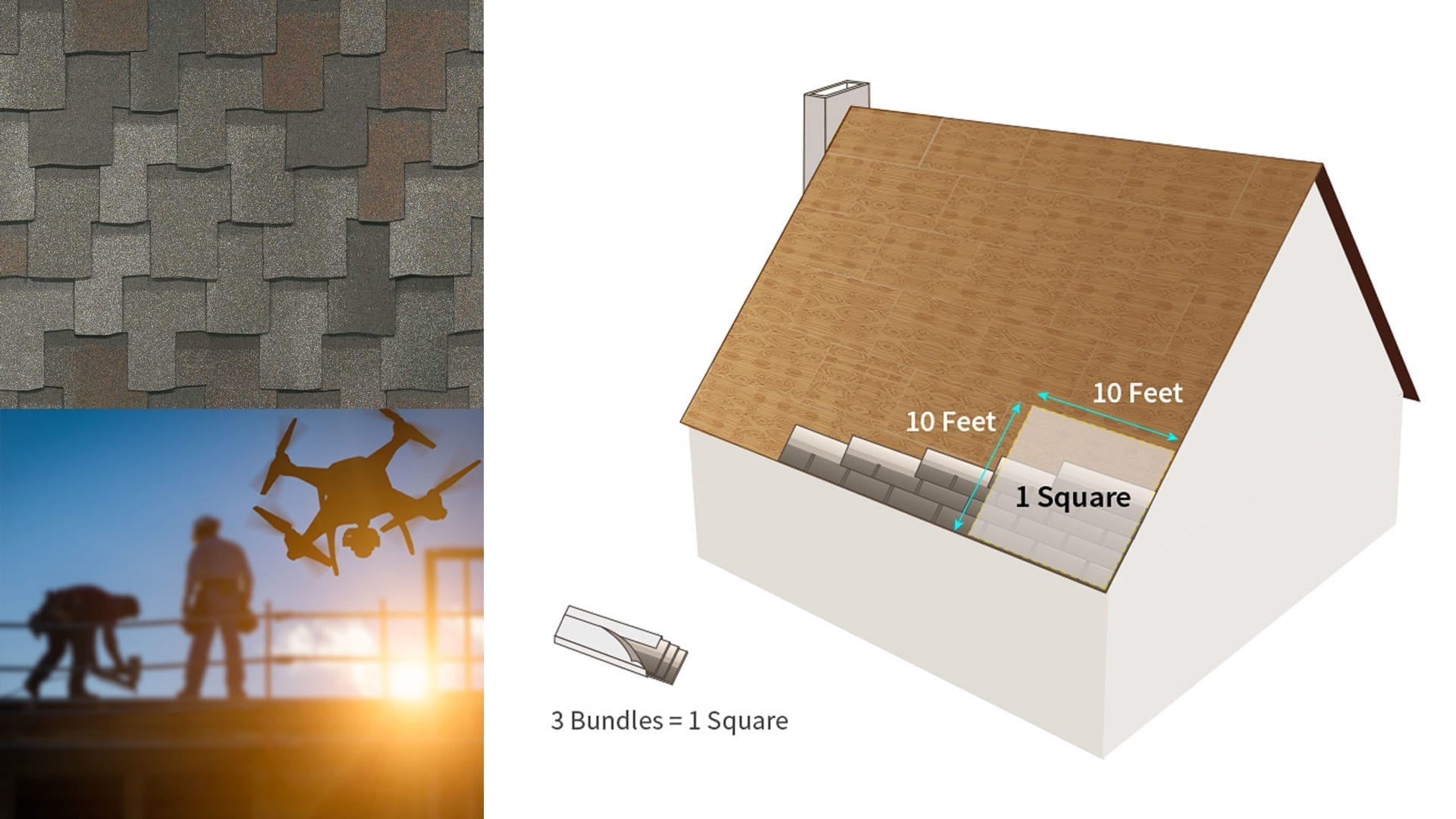
A roofing square is a unit of area equal to 100 square feet.
This terminology was adopted decades ago to simplify communication between manufacturers, suppliers, and contractors. Instead of saying, “I need 2,400 square feet of shingles,” a roofer will say, “I need 24 squares.” It streamlines ordering and reduces the chance of miscommunication regarding large numbers.
Why Do Roofers Use This Term?
The primary reason is efficiency. Roofs are large surfaces. Dealing with numbers in the thousands (e.g., 3,500 sq. ft.) is more prone to error than dealing with double-digit numbers (e.g., 35 squares). By standardizing the unit to 100 square feet, the industry created a common language that transcends regional differences.
How Many Square Feet In A Square Of Roofing Shingles?
To answer the core question directly: There are exactly 100 square feet in one square of roofing shingles.
This is a fixed industry standard. It does not change based on the brand of shingle, the type of material (asphalt, wood, slate), or the location of your home.
However, while the area is fixed at 100 square feet, the physical packaging varies. This is where many homeowners get confused. You cannot simply buy “one square” off the shelf. Instead, you buy bundles, and multiple bundles make up one square.
The Bundle-to-Square Ratio
Most standard three-tab asphalt shingles are packaged such that three bundles equal one square (100 sq. ft.).
- 1 Bundle ≈ 33.3 square feet
- 3 Bundles = 1 Square (100 square feet)
Important Note: This 3-bundle rule applies primarily to standard-weight asphalt shingles. If you are using heavier architectural shingles, laminated shingles, or different materials like cedar shakes or slate, the number of bundles per square may increase to four or even five. Always check the label on the bundle wrapper for the exact coverage.
Calculating Your Roof’s Square Footage
Knowing that one square equals 100 square feet is only half the battle. The other half is accurately measuring your roof to determine how many squares you actually need. Here is a step-by-step guide to doing this correctly.
Step 1: Measure Each Roof Plane
Most roofs are not simple flat rectangles. They have multiple planes, hips, valleys, and dormers. Break your roof down into simple geometric shapes (rectangles and triangles).
- Measure Length and Width: For each rectangular section, measure the length and width in feet.
- Calculate Area: Multiply length by width to get the square footage of that section.
- Example: A section that is 20 feet long and 10 feet wide is 20×10=200 square feet.
- Triangular Sections: For gable ends or triangular sections, multiply the base by the height and divide by two.
- Formula: (Base×Height)/2
Step 2: Sum Total Square Footage
Add the square footage of all individual sections together to get the total flat area of your roof.
Step 3: Convert to Squares
Divide your total square footage by 100.
- Example: If your total area is 2,400 sq. ft., then 2,400/100=24 squares.
Step 4: Account for Waste
You never buy the exact amount. You must account for cuts, starter strips, ridge caps, and mistakes. The general rule of thumb is to add 10% to 15% waste factor.
- Simple Roof (few valleys/hips): Add 10%.
- Complex Roof (many valleys/hips/turrets): Add 15–20%.
If you need 24 squares, adding 10% waste means you should order 26.4 squares (round up to 27 squares).
Factors That Influence Material Needs
While the math of “100 square feet per square” is constant, several real-world factors influence how much material you actually purchase.
| Factor | Impact on Material Order |
|---|---|
| Roof Pitch | Steeper roofs are harder to walk on and require more safety equipment, but the surface area calculation remains based on the footprint adjusted for slope. |
| Shingle Type | Architectural shingles are thicker and may require more bundles per square than 3-tab shingles. |
| Waste Factor | Complex roof lines with many valleys increase cut waste significantly. |
| Starter Strips | These are not included in the “square” count of field shingles and must be bought separately. |
For a deeper understanding of roofing components and standards, you can refer to general construction definitions on Wikipedia.
Common Mistakes to Avoid
Even with the right formula, errors happen. Here are the most common pitfalls:
- Ignoring the Pitch: Measuring only the home’s footprint (the ground floor area) underestimates the roof size. A steep roof has significantly more surface area than a flat one. Use a pitch multiplier if you are calculating from the ground.
- Forgetting Ridge Caps: The peak of your roof requires special ridge cap shingles. These are often sold separately or in specific boxes, not counted in the main square footage.
- Rounding Down: Always round up when buying bundles. If you need 2.1 squares, you must buy 3 squares (9 bundles). You cannot buy partial bundles easily, and running short mid-project causes delays and potential color mismatch issues if a new batch is ordered.
FAQ Section
1. Does a square of roofing always equal 100 square feet?
Yes. In the professional roofing industry in the United States, a “square” is universally defined as 100 square feet. This standard helps streamline estimates and material orders across different states and manufacturers.
2. How many bundles of shingles are in a square?
For standard 3-tab asphalt shingles, there are typically 3 bundles per square. However, for heavier architectural or dimensional shingles, it may take 4 or 5 bundles to cover 100 square feet. Always check the manufacturer’s specifications on the bundle wrap.
3. Can I calculate roofing squares from the ground?
You can get an estimate, but it won’t be precise. You would need to know the roof’s pitch (slope). Online calculators often use a “pitch multiplier” to adjust the footprint area. For accurate material ordering, physical measurement or drone imagery is recommended.
4. What is the difference between a “square” and a “bundle”?
A square is a unit of measurement equal to 100 square feet. A bundle is a physical package of shingles. You need multiple bundles to make one square. Think of it like buying soda: a “case” is the unit (like a square), and the individual cans are the bundles.
5. Do I need to buy extra shingles for future repairs?
It is highly recommended to keep 2–3 extra bundles stored in a dry place. Shingle colors can vary slightly between production batches. Having leftover shingles ensures that any future repairs will match the existing roof perfectly.
Conclusion
Understanding how many square feet in a square of roofing shingles is the foundation of any successful roofing project. Remember, one square always equals 100 square feet, but the number of bundles required to cover that area depends on the shingle type.
By accurately measuring your roof, converting that area into squares, and adding a appropriate waste factor, you can avoid budget overruns and material shortages. Don’t let the jargon intimidate you; with these simple calculations, you are well-equipped to plan your next roofing endeavor with confidence.
If you found this guide helpful, please share it with friends or family who might be planning home improvements. Accurate information saves money and stress!