Have you ever stood in the hardware aisle, staring at boxes of roofing nails, wondering if one coil will be enough or if you’ll end up making three extra trips to the store? It is a common frustration for both DIY enthusiasts and professional contractors alike. Knowing exactly how many nails are in a coil of roofing nails is crucial for accurate budgeting and ensuring your project runs smoothly without unnecessary delays.
In this guide, we will demystify the numbers behind roofing nail coils. We will look at standard industry counts, factors that change these numbers, and how to calculate exactly what you need for your specific roof size. Let’s dive in so you can get back to work with confidence.
Standard Counts: How Many Nails Are Typically in a Coil?
The short answer is: it depends. However, there are industry standards that most manufacturers follow. When you pick up a box of coil roofing nails, you are usually looking at counts ranging from 120 to 300 nails per coil.
The most common configurations you will find in US hardware stores and supply centers are:
- 120 Nails per Coil: Often found in larger diameter nails (like 3/8″ head) used for heavier shingles or slate.
- 160 Nails per Coil: A very common standard for general asphalt shingle roofing.
- 200–240 Nails per Coil: Frequently seen with smaller head nails (1/4″ head) designed for high-speed pneumatic nailers.
- 300 Nails per Coil: Less common for roofing, more typical for siding, but available for specific high-volume roofing applications using thinner gauge wires.
Why Do Counts Vary?
The variation isn’t random. It is dictated by the physical dimensions of the nail and the capacity of the plastic collation strip. Manufacturers balance the length of the nail, the thickness of the wire (gauge), and the size of the head to fit a specific number into a standard coil diameter that fits most roofing nail guns.
For instance, a 1-1/4 inch nail with a large 3/8-inch head takes up significantly more space than a 1-inch nail with a small 1/4-inch head. Therefore, fewer of the larger nails can fit into the same coil structure.
Factors That Determine Nail Count Per Coil
To truly understand how many nails are in a coil of roofing nails, you need to look at three specific variables. These factors determine whether you are holding a coil of 120 or 240.
1. Nail Head Diameter
This is the biggest factor. Roofing nails come primarily with two head sizes:
- Large Head (3/8″ or 7/16″): These provide better holding power for wind resistance but take up more room on the collation strip. You will typically see lower counts (120–160) for these.
- Small Head (1/4″): These are streamlined for speed and minimal surface disruption. Because they are smaller, manufacturers can pack more of them into a coil, often reaching 200–240 counts.
2. Nail Length and Gauge
Standard roofing nails range from 1 inch to 1-3/4 inches in length. The “gauge” refers to the thickness of the nail shaft.
- Thicker Gauge (11-gauge): Stronger, but bulkier. Fewer fit per coil.
- Thinner Gauge (12-gauge): Slightly more flexible, allows for higher counts per coil.
A 1-1/4 inch, 11-gauge nail will have a different count than a 1-3/4 inch, 11-gauge nail, even if the head size is the same, simply because the longer nail requires a wider coil diameter to wrap around, which may limit the total count due to weight and balance issues in the nail gun magazine.
3. Collation Type
Roofing nails are held together by plastic strip collation. The width and spacing of this plastic strip are standardized to fit major nail gun brands like Hitachi, Bostitch, and Milwaukee. However, slight variations in manufacturing tolerances can mean that one brand’s “160 count” coil might feel slightly tighter or looser than another’s, though the nominal count remains the same.
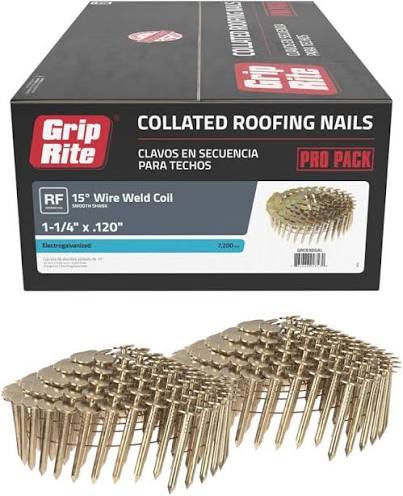
Comparison Table: Common Roofing Nail Coil Sizes
To make this easier to digest, here is a quick reference table based on popular US market products. Note: Always check the specific box label, as manufacturers can change specifications.
| Nail Length | Head Size | Wire Gauge | Typical Count Per Coil | Best Use Case |
|---|---|---|---|---|
| 1″ | 3/8″ | 11 | 120 – 160 | Underlayment, light shingles |
| 1-1/4″ | 3/8″ | 11 | 120 – 160 | Standard asphalt shingles |
| 1-1/4″ | 1/4″ | 11 | 200 – 240 | High-speed roofing, starter strips |
| 1-1/2″ | 3/8″ | 11 | 120 – 160 | Thicker shingles, wood shakes |
| 1-3/4″ | 3/8″ | 11 | 120 | Heavy-duty roofing, slate tiles |
How to Calculate How Many Coils You Need
Knowing the count is only half the battle. You need to know how many coils to buy. Here is a simple step-by-step method to estimate your needs.
Step 1: Determine Your Roof Square Footage
Measure the length and width of each plane of your roof. Multiply them to get the square footage. Add these together for the total area.
- Example: A 20×40 foot roof section = 800 sq ft.
Step 2: Estimate Nails Per Square Foot
For standard asphalt shingles, the general rule of thumb is 4 to 6 nails per shingle. Since there are roughly 3 shingles per square foot (depending on exposure), you generally need about 15–20 nails per square foot for the field of the roof. Ridge caps and starter strips require more density.
- Conservative Estimate: Use 20 nails per sq ft to be safe.
Step 3: Do the Math
Let’s say you have a 1,000 sq ft roof.
- 1,000 sq ft x 20 nails/sq ft = 20,000 nails needed.
If you are buying coils with 160 nails:
- 20,000 / 160 = 125 coils.
If you are buying coils with 120 nails:
- 20,000 / 120 = 167 coils.
Step 4: Add a Waste Factor
Always add 10% for waste, dropped nails, and misfires.
- 125 coils + 10% = ~138 coils.
It is always better to have a few extra coils left over than to run out mid-job. Most big-box stores allow returns of unopened boxes, so buying slightly more is a safe strategy.
Expert Insight: Quality Over Quantity
While counting nails is important, the quality of the nail matters just as much. According to industry standards, roofing nails should be hot-dipped galvanized or stainless steel to prevent rust stains from bleeding through your shingles.
For more detailed information on construction fasteners and corrosion resistance standards, you can refer to resources like Wikipedia’s article on Galvanization, which explains the chemical processes that protect your roof’s integrity over decades.
Using cheap, electro-galvanized nails might save you a few dollars now, but if they rust in five years, you could face costly leaks and aesthetic damage. Always prioritize hot-dipped galvanized coils, even if the count per box is slightly lower or the price is higher.
Frequently Asked Questions (FAQ)
Q: Can I use siding nails in my roofing nail gun?
A: Generally, no. While they may look similar, siding nails often have different head angles (usually 20-22 degrees) compared to roofing nails (often 15 degrees or straight). Additionally, siding nails may not be galvanized sufficiently for outdoor roof exposure. Using the wrong collation angle can jam your nail gun.
Q: What is the difference between 11-gauge and 12-gauge roofing nails?
A: The gauge refers to the thickness of the nail shaft. An 11-gauge nail is thicker and stronger than a 12-gauge nail. For standard asphalt shingles, 11-gauge is preferred for better wind uplift resistance. 12-gauge is sometimes used for lighter materials or underlayment.
Q: Do all roofing nail guns accept the same coil size?
A: No. Roofing nail guns are designed for specific coil diameters and collation types. Most professional roofing nailers accept standard plastic-collated coils, but you must check your tool’s manual. Some older models may only accept stick nails, not coils.
Q: How long do roofing nails last before rusting?
A: Hot-dipped galvanized roofing nails can last 20–30 years or more, depending on the environment. In coastal areas with salt air, stainless steel nails are recommended as they offer superior corrosion resistance compared to galvanized steel.
Q: Is it cheaper to buy stick nails or coil nails?
A: Coil nails are generally more expensive per nail than stick nails because of the added cost of the plastic collation and the convenience factor. However, coil nails allow for faster installation because you reload less often. For large roofing jobs, the time saved with coil nails usually outweighs the slight increase in material cost.
Conclusion
Understanding how many nails are in a coil of roofing nails is a small detail that makes a big difference in project planning. Whether you are dealing with 120-count large-head coils or 240-count small-head coils, accurate estimation prevents budget overruns and project delays.
Remember to measure your roof area carefully, choose the right gauge and galvanization for your climate, and always buy a little extra to account for waste. By combining the right knowledge with quality materials, you ensure your roof stands strong against the elements for years to come.
Did you find this guide helpful? Share it with your fellow DIYers or contractor friends on social media to help them tackle their next roofing project with confidence!