Replacing a roof is one of the most significant expenses a homeowner can face. It is a major investment in your property’s safety and value, often costing tens of thousands of dollars. Naturally, many homeowners ask, “Can you write off a roof replacement on your taxes?” to help alleviate this financial burden.
The short answer is nuanced: for most primary residences, the answer is no, but there are critical exceptions. Understanding these distinctions can save you from costly errors during tax season and help you maximize legitimate savings. In this guide, we will break down exactly when a new roof impacts your tax return and how to navigate IRS regulations effectively.
The General Rule: Personal Use vs. Business Use
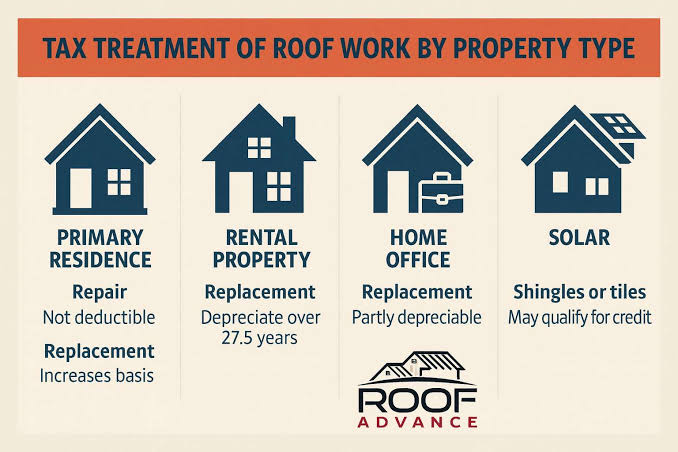
To understand why the IRS treats roof replacements differently than other expenses, we must look at the concept of “personal use.” The Internal Revenue Service (IRS) generally views your primary home as a personal asset, not a business investment. Therefore, routine maintenance and capital improvements—like a new roof—are considered personal living expenses.
Unlike medical expenses or charitable donations, you cannot deduct the cost of improving your personal home from your taxable income in the year you pay for it. This rule applies regardless of whether the roof was replaced due to age, storm damage, or aesthetic upgrades.
However, this does not mean the money is entirely “lost” in the eyes of the tax code. While you cannot take an immediate deduction, the cost may affect your capital gains when you eventually sell the home. By adding the cost of the roof to your home’s “basis,” you reduce the potential profit subject to taxation upon sale. For more detailed definitions of property basis, you can refer to the official IRS guidelines on Basis of Property, which align with general accounting principles found on resources like Wikipedia’s entry on Tax Basis.
Exception 1: Rental Properties and Business Use
If you own a rental property, the rules change dramatically. For landlords, a roof is not a personal expense; it is a necessary component of generating rental income. In this scenario, you can write off the cost, but the method depends on the nature of the work.
Repair vs. Improvement
The IRS distinguishes between a “repair” and an “improvement.”
- Repairs keep the property in good working condition without adding value or prolonging its life significantly (e.g., fixing a few missing shingles). These can be deducted fully in the current tax year.
- Improvements add value, prolong the useful life, or adapt the property to new uses (e.g., replacing the entire roof). These must be capitalized and depreciated over time.
For residential rental properties, the cost of a new roof is typically depreciated over 27.5 years using the Modified Accelerated Cost Recovery System (MACRS). This means you deduct a portion of the roof’s cost each year rather than all at once.
| Feature | Personal Residence | Rental Property |
|---|---|---|
| Immediate Deduction | No | No (must depreciate) |
| Depreciation | Not applicable | Yes, over 27.5 years |
| Impact on Sale | Increases basis (lowers capital gains) | Adjusted basis affects depreciation recapture |
| Repair Deduction | No | Yes, if minor |
Exception 2: Energy-Efficient Roofing Credits
While you may not get a direct deduction for a standard asphalt shingle roof, you might qualify for a federal tax credit if you install energy-efficient roofing materials. The Residential Clean Energy Credit and the Energy Efficient Home Improvement Credit are powerful tools for homeowners looking to upgrade.
As of recent tax years, homeowners can claim a credit for qualifying metal roofs with appropriate pigmented coatings or asphalt shingles designed to meet specific energy efficiency standards. These credits directly reduce your tax liability dollar-for-dollar, which is often more valuable than a deduction.
To qualify, the materials must meet the ENERGY STAR® program requirements. It is crucial to keep manufacturer certification statements and receipts. Unlike deductions, which lower your taxable income, credits lower your actual tax bill. If your tax liability is $5,000 and you have a $1,000 credit, you now owe $4,000.
Exception 3: Casualty Losses from Storm Damage
Sometimes, a roof replacement isn’t a choice—it’s a necessity due to sudden, unexpected events like hurricanes, hailstorms, or falling trees. In these cases, you may be able to claim a casualty loss.
However, the Tax Cuts and Jobs Act of 2017 significantly restricted casualty loss deductions. Currently, you can only deduct casualty losses if they are attributable to a federally declared disaster. Even then, there are hurdles:
- You must itemize deductions instead of taking the standard deduction.
- You must subtract $100 per event.
- You must subtract 10% of your adjusted gross income (AGI) from the total loss.
For example, if your AGI is $100,000, the first $10,000 of your loss (plus $100) is not deductible. This makes claiming casualty losses difficult for many taxpayers unless the damage is catastrophic and widespread.
How to Document Your Roof Replacement
Whether you are dealing with a rental property depreciation schedule or preparing for a future home sale, documentation is key. The IRS requires substantiation for all claims. Here is a step-by-step approach to keeping your records audit-proof:
- Keep All Receipts: Ensure invoices detail the materials used, labor costs, and dates of service.
- Save Contracts: The signed contract should specify the scope of work. Was it a full replacement or a repair? This distinction matters for rentals.
- Before and After Photos: Visual evidence can support claims of damage (for casualty losses) or proof of installation (for energy credits).
- Manufacturer Certifications: If claiming energy credits, save the specific ENERGY STAR® certification documents provided by the manufacturer.
- Insurance Correspondence: If insurance paid part of the cost, keep those records. You can only deduct or depreciate the amount you paid out-of-pocket, not what the insurance covered.
Frequently Asked Questions (FAQ)
1. Can I deduct a new roof if I work from home?
If you use part of your home exclusively and regularly for business, you may qualify for the Home Office Deduction. In this case, you can depreciate the portion of the roof that corresponds to the percentage of your home used for business. For example, if your home office is 10% of your home’s square footage, you can depreciate 10% of the roof’s cost over 39 years (non-residential real property rates often apply to home offices).
2. Does a new roof increase my home’s basis?
Yes. Capital improvements, such as a new roof, add to your home’s cost basis. When you sell your home, your profit is calculated as the selling price minus your basis. A higher basis means a lower taxable gain. Note that if you exclude up to $250,000 ($500,000 for married couples) of gain under Section 121, this may not impact your taxes immediately, but it is still good record-keeping.
3. Can I write off a roof replacement for a vacation home?
Generally, no. A second home used for personal purposes is treated the same as a primary residence. You cannot deduct maintenance or improvement costs. However, if you rent out the vacation home for part of the year, you may be able to deduct a portion of the expenses proportional to the rental use days, similar to a rental property.
4. What if my insurance paid for the roof?
If your insurance company covered the cost of the roof replacement due to storm damage, you cannot deduct that amount. You can only claim deductions or credits for expenses you actually paid. If insurance covered 80% of the cost, you can only factor in the remaining 20% for basis adjustments or depreciation.
5. Is there a time limit for claiming energy credits?
Tax credits are subject to annual legislative changes. The Inflation Reduction Act extended several energy credits through 2032. However, eligibility requirements and credit amounts can change. Always check the current year’s IRS Form 5695 instructions to ensure your roofing materials qualify for the current tax year.
Conclusion
So, can you write off a roof replacement on your taxes? For most homeowners with primary residences, the answer is no—not as an immediate deduction. However, the cost is not wasted. It increases your home’s basis, potentially lowering future capital gains taxes. For landlords, business owners, and those installing energy-efficient systems, significant tax benefits are available through depreciation, business deductions, and federal credits.
Navigating tax laws can be complex, and mistakes can be costly. Always keep meticulous records and consider consulting with a certified CPA or tax professional who can tailor advice to your specific financial situation.
Did you find this guide helpful? Share it with your friends on social media who might be facing a similar roofing dilemma!