Have you ever stared at your shiny new stand-up paddleboard (SUP), wondering how on earth you’re going to get it to the lake without scratching your car or losing your board on the highway? You are not alone. Transporting bulky water sports gear can be intimidating for beginners, but learning how to strap a paddle board to a roof rack is a crucial skill that ensures both your safety and the longevity of your equipment.
In this comprehensive guide, we will walk you through the exact steps professionals use to secure SUPs. We will cover everything from choosing the right straps to avoiding common mistakes that lead to costly damage. By the end of this article, you will feel confident loading your board like a pro.
Why Proper Strapping Matters for Your SUP
Before we dive into the “how,” let’s address the “why.” A paddle board is essentially a large sail when placed on a roof. Even at moderate speeds, wind resistance creates significant lift and drag forces. If your board is not secured correctly, these forces can shift the board, loosen straps, or even cause the board to fly off entirely.
According to transportation safety data, improperly loaded cargo is a leading cause of road hazards. Beyond safety, improper strapping can warp your board’s core or crack its fiberglass shell due to uneven pressure points. Taking five extra minutes to secure your load properly saves you hundreds, if not thousands, of dollars in repairs.
What Equipment Do You Need?
You do not need expensive, specialized gear to transport your SUP safely. However, using the right tools makes the process easier and more secure. Here is what you should have in your trunk:
- Cam Buckle Straps: These are superior to ratchet straps for SUPs. Ratchet straps can easily overtighten and crush the foam core of inflatable or soft-top boards. Cam buckles allow for tight, controlled tension.
- Roof Rack Crossbars: Ensure your vehicle has crossbars installed. If you have a bare roof, you will need a temporary soft-rack system.
- Padding or Towels: If your crossbars are metal or hard plastic, use neoprene pads or old towels to protect the board’s bottom from scratches.
- Leash or Lock Cable (Optional): For added security against theft when parked.
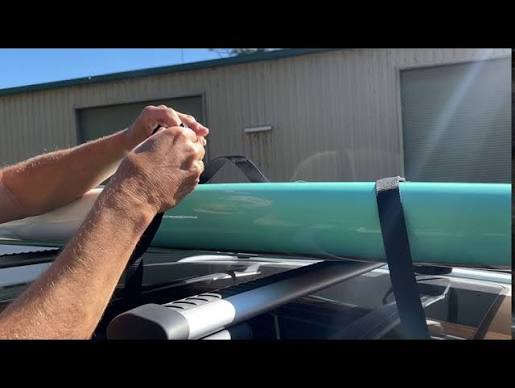
Step-by-Step: How to Strap a Paddle Board to a Roof Rack
Follow these precise steps to ensure a bulletproof setup. We recommend having a friend help you lift the board, though it is possible to do it alone with care.
Step 1: Position the Board Correctly
Place your paddle board on the roof rack with the fin box facing down. This is critical. The fin box is usually recessed, providing a natural channel for the strap to sit in, which prevents the board from sliding side-to-side. If your board has a removable fin, take it off to avoid breakage.
Ensure the board is centered on the crossbars. The nose (front) and tail (back) should overhang equally. For most standard cars, the board will extend beyond the windshield and rear window. This is normal, but ensure it does not obstruct your view or hit any sensors.
Step 2: Prepare the Straps
Take two cam buckle straps. Thread the loose end of the strap through the cam buckle mechanism before placing it on the board. It is much harder to do this once the board is in place.
Lay the straps over the board so that they align with your crossbars. One strap should go over the front crossbar, and the other over the rear crossbar. Ensure the buckles are positioned on the side of the car where you can easily access them.
Step 3: Secure the Straps Under the Car
Reach under the car and pull the loose ends of the straps through. Do not throw the straps over the board yet. Instead, bring the ends up to the top of the roof rack.
Tip: If you have a tall SUV or truck, you may need a step stool. Never climb on your car’s door frame or mirrors.
Thread the strap ends through the cam buckles. Make sure the webbing is flat and not twisted. Twisted straps reduce holding power and can wear out faster.
Step 4: Tighten with Precision
Pull the loose end of the strap to remove slack. Then, engage the cam buckle lever. Pull firmly until the strap is tight.
How tight is too tight? You want the strap to be snug enough that you cannot slide your hand easily between the strap and the board, but not so tight that it compresses the board’s surface significantly. If you see the board dimpling deeply under the strap, you have overtightened it. This is especially important for inflatable SUPs.
A good rule of thumb: The board should not move more than an inch when you push it sideways.
Step 5: Secure the Loose Ends
Loose strap ends flapping in the wind create noise and can distract other drivers. Use the elastic keepers on the straps to bundle the excess webbing. If your straps do not have keepers, tie a simple knot or use a rubber band to hold the excess material together.
Common Mistakes to Avoid
Even experienced paddlers make errors. Here are the most frequent issues and how to fix them:
| Mistake | Consequence | Solution |
|---|---|---|
| Using Ratchet Straps | Crushed foam core; warped board | Always use cam buckle straps or dedicated SUP ties. |
| Strapping Over the Fin | Broken fin; damaged fin box | Remove the fin or strap around the fin box channel. |
| Ignoring Wind Direction | Board lifts at high speeds | Place the nose facing forward. Check straps after 10 miles. |
| No Padding | Scratches on board bottom | Use neoprene pads or towels under the contact points. |
Understanding Wind Resistance and Aerodynamics
When you drive with a SUP on your roof, you are altering the aerodynamics of your vehicle. The board acts as a wing. According to principles of fluid dynamics, air moving over the curved top of the board creates lower pressure, which can generate lift.
This is why positioning matters. If the board is angled incorrectly, it can catch the wind like a sail, putting immense stress on your roof rack and straps. For more detailed information on aerodynamic forces, you can refer to general physics resources such as Wikipedia’s article on Aerodynamics.
To mitigate this:
- Keep speeds moderate (under 70 mph is ideal).
- Ensure the board is perfectly parallel to the direction of travel.
- Check your straps after the first 15–20 minutes of driving, as vibrations often loosen initial knots.
FAQ Section
1. Can I transport my paddle board without a roof rack?
Yes, you can use a “soft rack” system. These are heavy-duty straps with foam blocks that sit directly on your car’s roof. They pass through the car doors and tighten inside the cabin. While convenient, they are generally less secure than hard crossbars and are not recommended for highway speeds above 65 mph.
2. Should I transport my SUP upside down or right side up?
Always transport your SUP upside down (deck pad facing down, fin box facing up). Wait, correction: In the previous steps, we mentioned fin box down. Let’s clarify.
- Hard Boards: Usually transported bottom up (fin box facing up) if using a cradle rack. However, if using flat crossbars, many prefer deck down (fin box facing down) to protect the delicate deck pad and use the fin box channel for strap stability. Check your specific board manufacturer’s recommendation. Most modern racks suggest deck down to protect the finish.
- Inflatable Boards: Deck down is preferred to protect the valve and deck pad texture.
(Note: Always prioritize the manufacturer’s specific advice for your board model.)
3. How many straps do I need?
You need a minimum of two straps, one for each crossbar. If your board is exceptionally long (over 12 feet) or if you only have one crossbar, you should use additional straps or a specialized long-board kit to prevent flexing and bouncing.
4. Is it safe to leave my paddle board on the roof overnight?
It is not recommended. Besides the risk of theft, temperature changes can affect the board. Direct sunlight can heat up the air inside an inflatable board, potentially causing it to burst if over-inflated. Hardboards can also warp if exposed to extreme heat while strapped down tightly. Always unload your board when not in use.
5. What if my car doesn’t have roof rails?
If your car has a smooth roof, you must use a soft rack system or install aftermarket crossbars that clamp onto the door frames. Never attempt to strap a board directly to a bare metal roof without padding, as this will damage both your car’s paint and the board.
Conclusion
Learning how to strap a paddle board to a roof rack is a simple yet vital skill for any paddler. By using the right equipment—specifically cam buckle straps—and following the correct positioning techniques, you can transport your gear safely and efficiently. Remember to check your straps regularly, respect wind conditions, and always prioritize the protection of your board’s structure.
Now that you are equipped with this knowledge, you are ready to hit the water with peace of mind. Did you find this guide helpful? Share it with your paddling buddies on social media to help them transport their gear safely too! Happy paddling!