Tag: IRS Publication 523

  • Can I Write Off A New Roof On My Taxes?

    Can I Write Off A New Roof On My Taxes?

    Replacing a roof is one of the most significant financial investments a homeowner can make. It is not just about shingles and nails; it is about protecting your family and your asset from the elements. However, when the bill arrives, many homeowners immediately ask: Can I write off a new roof on my taxes?

    The short answer is nuanced. For most primary residences, you cannot deduct the cost as an immediate expense. However, there are critical exceptions involving energy efficiency, home offices, and rental properties that could put money back in your pocket. This guide breaks down the complex tax code into clear, actionable advice so you know exactly where you stand with the IRS.

    Understanding the Difference Between Repairs and Improvements

    To understand tax implications, you must first distinguish between a “repair” and a “capital improvement.” The Internal Revenue Service (IRS) treats these two categories very differently.

    A repair keeps your property in good working condition but does not add significant value or prolong its life. Think of fixing a few loose shingles or patching a small leak. These costs are generally not deductible for personal residences.

    A replacement, however, is considered a capital improvement. It adds value to your home, prolongs its useful life, or adapts it to new uses. Since a new roof typically lasts 20–30 years, it falls squarely into this category.

    Why This Distinction Matters

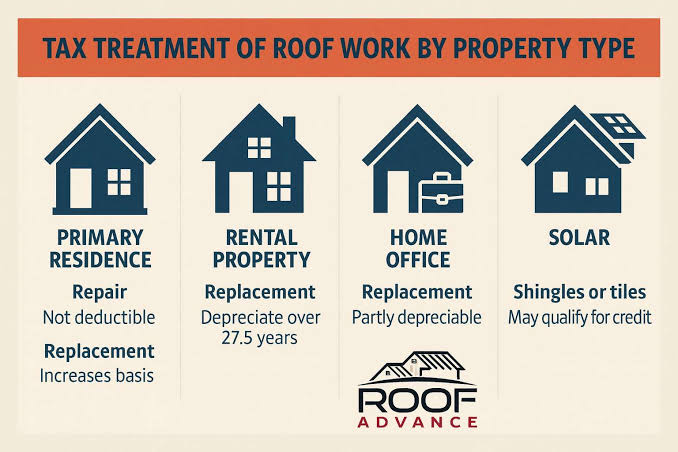
    For a personal home, capital improvements are not deducted from your annual income. Instead, they increase your home’s basis. This is crucial when you eventually sell the house, as a higher basis reduces your potential capital gains tax. You can read more about how basis works on Wikipedia, which provides a solid overview of accounting principles relevant to property valuation.

    When Can You Actually Deduct Roof Costs?

    While the general rule says “no immediate deduction,” several specific scenarios allow for tax benefits. Let’s explore who qualifies.

    1. The Home Office Deduction

    If you use part of your home exclusively and regularly for business, you may qualify for the home office deduction. In this case, you can depreciate the portion of the roof that covers your office space.

    • Example: If your home office occupies 10% of your home’s square footage, you can claim 10% of the roof replacement cost.
    • Method: This is usually done through depreciation over 39 years for non-residential property or via the simplified option for home-based businesses.

    2. Rental Properties and Landlords

    If you own a rental property, the rules change significantly. The IRS views rental activities as a business. Therefore, you can recover the cost of a new roof through depreciation.

    • Residential Rental Property: Depreciated over 27.5 years.
    • Commercial Property: Depreciated over 39 years.

    You do not get the full deduction in year one. Instead, you take a portion of the cost each year as an expense against your rental income. This lowers your taxable rental profit annually.

    3. Energy-Efficient Roofing Credits

    This is the most common way homeowners get direct tax relief. The Inflation Reduction Act has expanded credits for energy-efficient home improvements.

    If your new roof includes specific energy-saving materials, you may qualify for the Energy Efficient Home Improvement Credit.

    • Eligible Materials: Metal roofs with appropriate pigmented coatings or asphalt shingles designed to meet strict Energy Star criteria for cooling.
    • Credit Amount: As of recent tax years, you can claim 30% of the cost of qualifying materials, up to a maximum credit of $1,200 per year for various improvements. Note that the credit applies to materials, not necessarily labor, though rules vary by specific program updates.
    Can I Write Off A New Roof On My Taxes

    Step-by-Step: How to Claim Roof-Related Tax Benefits

    If you believe you qualify for a deduction or credit, follow these precise steps to ensure compliance with IRS guidelines.

    1. Verify Eligibility: Confirm your roof meets Energy Star standards or that your home office/rental status is documented.
    2. Keep Detailed Records: Save all invoices, receipts, and manufacturer certifications. The IRS requires proof that the materials meet specific energy efficiency standards.
    3. Calculate the Basis Adjustment: For personal homes, add the total cost of the roof (materials + labor) to your home’s original purchase price. Keep this record for when you sell.
    4. Fill Out Form 5695: If claiming the energy credit, complete IRS Form 5695 (Residential Energy Credits).
    5. Report Rental Depreciation: Use Form 4562 (Depreciation and Amortization) for rental properties.

    Pro Tip: Always consult with a Certified Public Accountant (CPA). Tax laws change frequently, and a professional can ensure you maximize your benefits without triggering an audit.

    Comparison: Personal Home vs. Rental Property

    To clarify the differences, here is a quick comparison table:

    FeaturePrimary ResidenceRental PropertyHome Office
    Immediate DeductionNoNo (Depreciated)Yes (Partial)
    Tax Benefit TypeBasis IncreaseAnnual DepreciationPartial Depreciation
    Energy CreditsYes (If qualified)No (Usually)No (Usually)
    Impact on SaleReduces Capital GainsRecaptured DepreciationN/A

    Common Mistakes to Avoid

    Many taxpayers make errors when handling roof expenses. Here are the top pitfalls:

    • Claiming Full Cost for Personal Use: Never deduct the entire cost of a new roof on your primary home as a medical or charitable expense unless strictly applicable (which is rare).
    • Ignoring Labor Costs in Basis: When adjusting your home’s basis, include both materials and labor. Excluding labor undervalues your investment.
    • Missing Deadlines: Energy credits must be claimed in the tax year the installation was completed. You cannot go back and claim them easily after filing.

    FAQ Section

    Can I write off a new roof on my taxes if it was damaged by a storm?

    Generally, no. Casualty losses from storms are only deductible if they occur in a federally declared disaster area. Even then, you must subtract insurance reimbursements and a $100 floor per event, plus 10% of your adjusted gross income. Most standard storm damage does not meet this high threshold anymore due to recent tax law changes.

    Does a new roof increase my home’s basis?

    Yes. Any capital improvement, including a new roof, increases your home’s cost basis. This is beneficial because when you sell your home, a higher basis means a lower calculated profit, potentially reducing or eliminating capital gains tax if you exceed the exclusion limits ($250k for single filers, $500k for married couples).

    What documents do I need to prove my roof is energy efficient?

    You need the Manufacturer’s Certification Statement. This document confirms that the product meets the Energy Star program requirements. Your contractor should provide this, or you can download it from the manufacturer’s website. Keep this with your tax records for at least three years after filing.

    Can I deduct the cost of a roof repair?

    For a personal residence, routine repairs are not deductible. They are considered maintenance. However, if the repair is part of a larger renovation project that qualifies as a capital improvement, it might be included in the basis adjustment. For rental properties, repairs can often be deducted as current business expenses.

    Is there a limit to how much I can claim for energy-efficient roofing?

    Yes. Under current laws, the Energy Efficient Home Improvement Credit has an annual cap. For example, the credit for building envelope components (like roofs) is limited to $1,200 per year. Always check the latest IRS guidelines for the specific tax year you are filing.

    Conclusion

    So, can I write off a new roof on my taxes? For most homeowners, the answer is no—not as a direct annual deduction. However, you can still benefit financially by increasing your home’s basis for future sales or claiming energy-efficient credits if you choose eco-friendly materials. Landlords and home office users have additional avenues for depreciation.

    Understanding these nuances ensures you don’t leave money on the table while staying compliant with federal laws. Always keep meticulous records and consider consulting a tax professional to navigate your specific situation.

    Found this guide helpful? Share it with your friends on social media who are planning home renovations this year!
  • Can You Write Off A New Roof On Your Taxes?

    Can You Write Off A New Roof On Your Taxes?

    Replacing a roof is one of the most significant home maintenance expenses a homeowner can face. It is a massive financial hit that often comes unexpectedly, leaving many people scrambling to manage their budget. Naturally, you might be asking yourself: Can you write off a new roof on your taxes? The short answer is complex because it depends entirely on how you use the property. For most primary residences, the answer is no, but there are crucial exceptions and strategies for landlords and energy-efficient upgrades that can significantly reduce your tax liability.

    In this guide, we will break down the intricate rules set by the Internal Revenue Service (IRS). We will explore the difference between repairs and improvements, explain how depreciation works for rental properties, and highlight potential tax credits for green energy roofing materials. By the end of this article, you will have a clear understanding of your options and know exactly what documentation you need to keep.

    Understanding the Difference Between Repairs and Improvements

    To understand tax implications, you must first distinguish between a “repair” and an “improvement” in the eyes of the IRS. This distinction is the foundation of all real estate tax deductions.

    A repair keeps your property in good working condition but does not add significant value or prolong its life. Examples include fixing a few missing shingles or patching a small leak. These costs are generally not deductible for personal homes.

    An improvement, however, adds value to the property, prolongs its useful life, or adapts it to new uses. A full roof replacement is almost always classified as an improvement. According to IRS guidelines on capital improvements, these costs cannot be deducted immediately from your taxable income for a primary residence. Instead, they are added to the basis of your home.

    Why Does Basis Matter?

    When you eventually sell your home, a higher basis reduces your capital gains tax. While you do not get an immediate tax break, you may pay less tax when you sell the property. However, if you are renting out the property, the rules change dramatically.

    Tax Rules for Primary Residences

    For the majority of Americans who live in the homes they own, the news regarding roof replacements is often disappointing. You generally cannot deduct the cost of a new roof on your federal income tax return in the year you pay for it.

    The IRS views personal living expenses as non-deductible. Since a roof is part of the structure you live in, it falls under personal maintenance. However, there is a silver lining related to energy efficiency, which we will discuss later.

    Key Takeaways for Homeowners:

    • No Immediate Deduction: You cannot subtract the cost from your annual income.
    • Adjust Your Basis: Keep all receipts. Add the cost of the roof to your home’s original purchase price. This lowers your profit margin when you sell, potentially saving you money on capital gains tax if your profit exceeds the exclusion limits ($250,000 for single filers, $500,000 for married couples filing jointly).
    • Medical Necessity Exception: In rare cases, if a doctor prescribes a specific home modification for medical reasons, it might be deductible as a medical expense. However, a standard roof replacement rarely qualifies unless it involves specific structural changes for accessibility.

    Tax Benefits for Rental Property Owners

    If you own a rental property, the answer to “Can you write off a new roof on your taxes?” becomes a resounding yes, but not all at once. Rental properties are considered business assets, and the IRS allows you to recover the cost of improvements through depreciation.

    How Depreciation Works

    Depreciation lets you deduct a portion of the roof’s cost each year over its “useful life.” For residential rental property, the IRS typically assigns a useful life of 27.5 years to the building structure, including the roof.

    Here is a simplified example:

    1. You spend $15,000 on a new roof for your rental duplex.
    2. You divide $15,000 by 27.5 years.
    3. You can deduct approximately $545 per year from your rental income for nearly three decades.

    This annual deduction reduces your taxable rental income, lowering your overall tax bill. It is crucial to start depreciating the asset in the year it is placed in service.

    Bonus Depreciation and Section 179

    In recent years, tax laws have allowed for “Bonus Depreciation,” which permits businesses to deduct a large percentage of the cost of qualified property in the first year. However, tax laws change frequently. As of recent updates, bonus depreciation percentages have been phasing down. Always consult with a CPA to see if your specific roof replacement qualifies for accelerated depreciation under current laws.

    Can You Write Off A New Roof On Your Taxes

    Energy-Efficient Roof Tax Credits

    While you may not get a direct deduction for a standard asphalt shingle roof, you might qualify for a tax credit if you install energy-efficient roofing materials. Tax credits are more valuable than deductions because they reduce your tax bill dollar-for-dollar.

    The Residential Clean Energy Credit (formerly part of the Nonbusiness Energy Property Credit) offers incentives for installing solar roofing tiles or other renewable energy systems. Additionally, certain metal roofs with pigmented coatings or asphalt roofs with cooling granules may qualify if they meet specific Energy Star standards.

    Requirements for Energy Credits:

    • The product must meet specific energy-efficiency criteria set by the Department of Energy.
    • You must install it in your existing primary residence.
    • You must have a manufacturer’s certification statement.

    For example, if you install a solar roof that generates electricity, you could claim a credit worth 30% of the total installation cost through 2032 under the Inflation Reduction Act. This is a massive potential saving compared to a standard deduction.

    Step-by-Step Guide: Documenting Your Roof Replacement

    Whether you are a landlord depreciating the cost or a homeowner adjusting your basis, documentation is vital. The IRS requires proof of expenditure. Follow these steps to ensure you are audit-proof:

    1. Get Itemized Invoices: Do not just keep a final receipt. Request an itemized invoice from your contractor that breaks down labor, materials, and disposal fees.
    2. Save Proof of Payment: Keep canceled checks, credit card statements, or bank transfer records showing the payment was made.
    3. Before and After Photos: Take dated photos of the old roof and the new installation. This proves the work was completed and helps distinguish between a repair and a full replacement.
    4. Manufacturer Warranties: Keep copies of warranties for materials used. This helps establish the “useful life” of the asset for depreciation purposes.
    5. Store Digitally and Physically: Scan all documents and store them in a secure cloud folder. Keep physical copies in a fireproof safe for at least seven years after you file the tax return for the year you sell the property.

    Comparison: Personal Home vs. Rental Property

    To clarify the differences, here is a quick comparison table:

    FeaturePrimary ResidenceRental Property
    Immediate DeductionNoNo (usually depreciated)
    Tax Benefit TypeAdjusted Basis (Capital Gains)Depreciation Expense
    Energy CreditsYes (if qualified)Generally No (business rules apply)
    Documentation NeedHigh (for future sale)Very High (annual audits)
    Useful Life SpanN/A27.5 Years

    Frequently Asked Questions (FAQ)

    1. Can I deduct a partial roof repair?

    For a primary residence, no. Partial repairs are considered personal maintenance. For a rental property, routine repairs can often be deducted fully in the year they occur, unlike replacements which must be depreciated. The line between repair and improvement is thin, so consult a tax professional.

    2. Does a new roof increase my home’s value for tax purposes?

    It increases your basis, not your immediate taxable income. A higher basis means you recognize less profit when you sell the home, which can protect you from capital gains taxes if your home’s value has appreciated significantly.

    3. What if I use my home for business (Home Office)?

    If you have a qualified home office, you may be able to depreciate a portion of the roof. For example, if your home office takes up 10% of your home’s square footage, you might be able to depreciate 10% of the roof’s cost over 39 years (commercial property rate) or 27.5 years, depending on specific IRS interpretations for mixed-use property. This is complex; professional advice is recommended.

    4. Are there state-level tax deductions for roofs?

    Yes. Some states offer additional rebates or tax credits for energy-efficient improvements or storm-resistant roofing. Check with your state’s department of revenue or local utility companies for specific programs.

    5. How long should I keep my roof replacement records?

    Keep records for at least three years from the date you filed your original return or two years from the date you paid the tax, whichever is later. However, for home improvements affecting basis, keep them until you sell the home plus three years.

    Conclusion

    So, can you write off a new roof on your taxes? For most homeowners, the answer is no—not as an immediate deduction. However, it is not a total loss. By adding the cost to your home’s basis, you reduce future capital gains tax. For rental property owners, depreciation offers a steady, long-term tax benefit. And for those willing to invest in green technology, energy tax credits can provide substantial immediate savings.

    Navigating tax laws can be tricky, and mistakes can be costly. Always keep meticulous records and consider consulting with a certified public accountant (CPA) to tailor these strategies to your specific financial situation.

    Did you find this guide helpful? Share it with your friends and family on social media to help them save money on their next home improvement project!