Have you ever walked into an indoor sports complex and felt immediately overwhelmed by the chaotic layout? You are not alone. Many facility managers and enthusiasts struggle to decode the essential Indoor Football Pitch Net Mesh Seats Metal Roof Location Clue that dictates whether a venue is safe, functional, and profitable. Understanding how these elements interact is the key to creating a world-class playing environment.
In this comprehensive guide, we will break down the critical components of indoor football infrastructure. We will explore why specific materials are chosen, how location impacts performance, and what modern standards dictate for your next project or visit.
Decoding the “Location Clue” in Facility Design
When architects and engineers discuss the “location clue,” they are rarely talking about a geographic coordinate. Instead, they refer to the spatial relationship between the playing surface and its surrounding infrastructure. This concept is vital for maximizing space efficiency while ensuring player safety.
The location clue helps determine where barriers should be placed relative to the goal lines and touchlines. For instance, placing heavy metal support columns too close to the pitch can create dangerous blind spots for goalkeepers. Conversely, positioning spectator seats too far back diminishes the atmosphere, while placing them too close compromises safety zones.
According to urban planning principles often cited in Wikipedia’s article on Sports Architecture, the orientation of the building and the internal layout significantly affect lighting conditions and airflow. A well-decoded location clue ensures that the sun’s glare does not interfere with play during daytime matches and that ventilation systems effectively remove heat generated by intense physical activity.
Key Spatial Considerations
- Buffer Zones: Maintain at least 2–3 meters of clear space behind the goals.
- Sightlines: Ensure every seat has an unobstructed view of the entire pitch.
- Access Points: Locate emergency exits away from high-traffic player tunnels.
The Critical Role of Net Mesh Systems
One of the most misunderstood aspects of indoor football is the netting system. It is not just about keeping the ball in play; it is about energy absorption and visibility.
Why Mesh Density Matters
Not all nets are created equal. The “mesh” refers to the size of the openings in the net. For professional indoor football (futsal or 5-a-side), a smaller mesh is preferred. Why? Because a tighter mesh reduces the chance of the ball getting stuck and provides a clearer view for spectators sitting behind the goals.
- Standard Mesh Size: 40mm x 40mm is common for general practice.
- Professional Mesh Size: 20mm x 20mm offers better durability and visibility.
Material Durability
High-density polyethylene (HDPE) is the industry standard. It resists UV degradation (important if your facility has skylights) and withstands the high-velocity impact of a kicked ball. A poor-quality net will fray within months, creating a safety hazard and requiring frequent, costly replacements.
Expert Tip: Always choose knotted nets over knotless ones for high-impact areas. While knotless nets look smoother, knotted nets distribute the force of impact more evenly across the structure, extending the lifespan of the anchoring points.
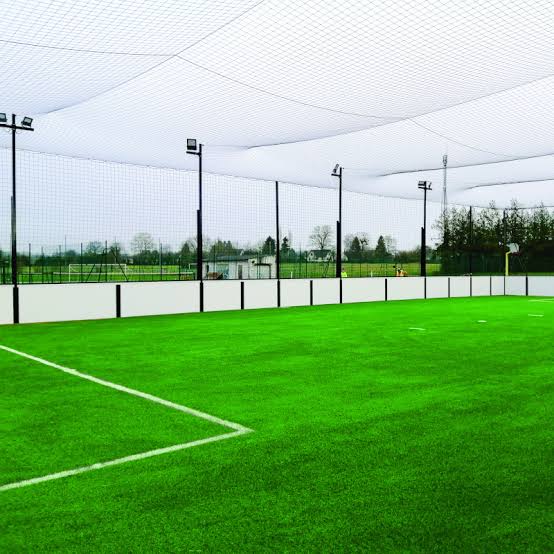
Metal Roof Structures: Engineering for Acoustics and Light
The roof is the crown of any indoor facility. When we specify a metal roof, we are prioritizing longevity and structural span. Unlike concrete, metal allows for wider open spaces without internal support columns, which is crucial for an unobstructed football pitch.
Thermal and Acoustic Challenges
Metal roofs are excellent for shedding rain and snow, but they present two major challenges for indoor sports: heat retention and noise amplification.
- Heat: Metal conducts heat. In summer, an uninsulated metal roof can turn an indoor pitch into a sauna. Modern solutions involve using insulated sandwich panels with a polyurethane core. This maintains a comfortable temperature between 18–22°C, ideal for athletic performance.
- Noise: The sound of a ball hitting a metal roof can be deafening. To mitigate this, acoustic baffles or spray-on foam insulation are applied to the underside of the roof deck. This absorbs sound waves, reducing echo and allowing coaches to communicate effectively with players.
Structural Integrity
A typical indoor football span requires a clear width of 20–30 meters. Steel trusses are engineered to handle not just the weight of the roof, but also dynamic loads such as wind uplift and potential snow accumulation, depending on the location clue of the facility’s geographic region.
Seating Solutions: Comfort Meets Capacity
The seating arrangement defines the spectator experience. In indoor facilities, space is at a premium. Therefore, the choice between fixed seats, retractable bleachers, or standing areas is critical.
Fixed vs. Retractable Seating
| Feature | Fixed Seats | Retractable Bleachers |
|---|---|---|
| Comfort | High (individual backs/arms) | Medium (bench style) |
| Space Efficiency | Low (permanent footprint) | High (can be stored away) |
| Cost | Higher initial investment | Lower initial cost |
| Best For | Professional leagues, VIP areas | Multi-purpose community halls |
The “Mesh Seat” Trend
Recently, there has been a surge in popularity for mesh seats. These are not seats made of netting, but rather perforated metal or plastic chairs. Why are they trending?
- Ventilation: They allow air to circulate, preventing sweat buildup during long tournaments.
- Drainage: If the facility is used for other wet sports or requires hosing down, water drains through instantly.
- Durability: They are nearly indestructible compared to upholstered stadium chairs.
For an indoor football pitch, opting for mesh-backed seating in the lower tiers provides a modern aesthetic while ensuring hygiene and comfort.
Integrating the Elements: A Step-by-Step Design Approach
If you are planning a facility, here is how you integrate the Indoor Football Pitch Net Mesh Seats Metal Roof Location Clue into a cohesive design.
- Analyze the Location: Determine the cardinal direction. Orient the pitch North-South to minimize sun glare through any side windows. Check local zoning laws for height restrictions regarding the metal roof.
- Erect the Structure: Install the steel framework. Ensure the roof trusses are spaced to allow for proper lighting rig attachment points every 4–5 meters.
- Install the Roofing: Apply insulated metal panels. Seal all joints meticulously to prevent leaks, which can damage the wooden or synthetic turf below.
- Mount the Netting: Install perimeter netting before laying the floor. Anchor the net posts into the concrete foundation, not just the floor surface, to withstand high-impact shots. Use a 20mm HDPE mesh for professional standards.
- Configure Seating: Install retractable bleachers along one long side for flexibility. Install fixed mesh seats along the opposite side for premium ticket holders. Ensure aisle widths are at least 1.2 meters for safety compliance.
- Final Touches: Add acoustic dampening to the roof interior and install LED lighting calibrated to 500 lux for training and 800 lux for matches.
FAQ Section
1. What is the ideal height for an indoor football pitch roof?
The minimum recommended height is 7 meters (23 feet) for recreational play. However, for competitive matches, a clearance of 9–12 meters (30–40 feet) is preferred to allow for high lobs and headers without the ball hitting the structure.
2. Why is HDPE mesh preferred over nylon for indoor nets?
HDPE (High-Density Polyethylene) is superior because it is resistant to moisture, mildew, and UV rays. Nylon absorbs water, which can lead to stretching and sagging over time, altering the tension and safety of the barrier.
3. Can I install a metal roof without insulation?
Technically yes, but it is highly discouraged. Without insulation, condensation will form on the underside of the metal during temperature changes, leading to dripping water on the pitch. This creates a slip hazard for players and accelerates corrosion of the steel structure.
4. How many seats should I plan for a standard 5-a-side pitch?
For a standard 5-a-side pitch (approx. 25m x 15m), a capacity of 50–100 seats is usually sufficient. This allows for family viewing and small crowds without overcrowding the limited indoor footprint. Using retractable seating allows you to expand this number for special events.
5. What is the “Location Clue” regarding ventilation?
The location clue refers to positioning air intakes and exhaust fans based on the prevailing wind direction and the building’s orientation. Proper placement ensures that stale air and heat are expelled efficiently, maintaining oxygen levels for high-intensity sports.
6. Are mesh seats comfortable for long-duration tournaments?
Yes, modern ergonomic mesh seats are designed with contoured shapes that support the spine. The breathable material prevents heat buildup, making them actually more comfortable than padded vinyl seats in warm indoor environments.
Conclusion
Designing or evaluating an indoor football facility requires a holistic understanding of its components. The Indoor Football Pitch Net Mesh Seats Metal Roof Location Clue is not just a jumble of keywords; it is a blueprint for success. By prioritizing the right net mesh for safety, a metal roof for structural integrity, appropriate seating for comfort, and a smart location strategy for functionality, you create a venue that players love and owners profit from.
Whether you are a facility manager looking to renovate or an enthusiast curious about what makes a great arena, remember that details matter. The right materials and layout transform a simple room into a professional sports hub.
Did you find this guide helpful? Share this article with your local sports club or facility manager on social media to help raise the standards of indoor football in your community!