Planning a roofing project can feel overwhelming, especially when you are staring up at complex angles and wondering, how do you figure out square footage of a roof? You are not alone; accurate measurements are the absolute foundation of any successful roof replacement or repair, saving you from costly material overruns or dangerous mid-project shortages. In this guide, we will walk you through simple, proven methods to calculate your roof’s area safely and accurately, even if you are a complete beginner.
How Do You Figure Out Square Footage Of A Roof: The Basics
Before grabbing a tape measure, it is crucial to understand that your roof’s square footage is not the same as your home’s floor square footage. A roof covers the top of your house and extends beyond the exterior walls (the eaves), and it slopes upward, which adds significant surface area.
In the roofing industry, professionals do not typically talk in standard square feet. Instead, they use a unit called a “roofing square.”
- 1 Roofing Square = 100 square feet of roof area.
For example, if your roof is 2,400 square feet, a contractor will refer to it as a “24-square roof.” Understanding this terminology will help you communicate effectively with suppliers and contractors, ensuring you order the correct amount of shingles, underlayment, and nails.
Step-by-Step Guide to Measuring Your Roof
Calculating your roof area does not require an advanced degree in mathematics. By following this logical, step-by-step tutorial, you can get a highly accurate estimate.
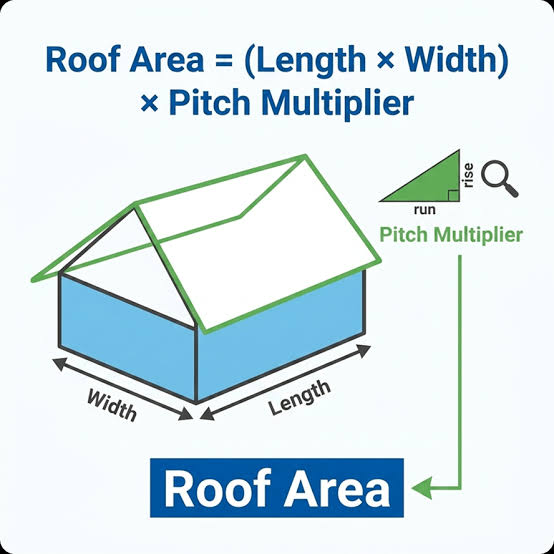
Step 1: Measure the Home’s Footprint
Start by measuring the length and width of your home’s exterior walls. Do not forget to include the overhangs (eaves), which typically extend 1 to 2 feet beyond the walls on each side.
- Example: If your home’s main section is 40 feet long and 30 feet wide, and you have a 1-foot overhang on all sides, your adjusted dimensions are 42 feet by 32 feet.
- Footprint Area: 42 ft × 32 ft = 1,344 square feet.
Step 2: Determine the Roof Pitch
Roof pitch (or slope) dictates how steep your roof is. A steeper roof has more surface area than a flat roof of the same footprint. You can measure this from the ground or inside your attic.
- Place a 12-inch level horizontally against the underside of a roof rafter in the attic.
- Measure the vertical distance from the 12-inch mark on the level straight up to the rafter.
- If that distance is 6 inches, your roof pitch is 6/12 (read as “six in twelve”).
Step 3: Apply the Pitch Multiplier
Once you know the pitch, you must multiply your footprint area by a specific “pitch multiplier” to account for the slope.
| Roof Pitch | Pitch Multiplier |
|---|---|
| 3/12 (Low Slope) | 1.031 |
| 4/12 (Moderate) | 1.054 |
| 6/12 (Common) | 1.118 |
| 8/12 (Steep) | 1.202 |
| 12/12 (Very Steep) | 1.414 |
- Calculation Example: Using our 1,344 sq ft footprint and a 6/12 pitch:
1,344 × 1.118 = 1,502.59 square feet.
This equals roughly 15 roofing squares.
How to Measure a Roof with Multiple Slopes and Valleys
Most modern homes do not have a simple, single-plane gable roof. They feature hips, valleys, dormers, and multiple intersecting slopes. How do you handle this complexity? Break it down into simple geometric shapes.
- Sketch the Roof: Draw a basic top-down diagram of your roof.
- Divide into Planes: Separate the roof into individual rectangles and triangles.
- Measure Each Plane: Calculate the length and width of each individual section.
- Calculate and Sum: Find the area of each plane (Length × Width), apply the pitch multiplier to each, and add them all together.
Pro Tip: According to the National Association of Home Builders (NAHB), inaccurate measurements account for up to 15% of wasted roofing materials on complex roofs. Taking the time to map out each plane individually drastically reduces this waste.
Can You Measure Roof Square Footage from the Ground?
Yes, and it is often the safest method. Climbing onto a roof without proper safety harnesses and equipment is a leading cause of home improvement injuries.
If you cannot access the attic to check the pitch, you can estimate it from the ground using a smartphone app designed for angle measurement, or by counting the shingles. Standard architectural shingles expose about 5 inches to the weather. If you count 12 shingle exposures from the eave to the ridge, your roof rises 60 inches (5 feet) over a certain horizontal distance, helping you deduce the pitch.
For advanced DIYers, understanding the geometry of a roof pitch is invaluable. Alternatively, you can use free satellite imagery tools like Google Earth. By using the polygon measurement tool, you can trace the edges of your roof directly on the satellite map to get a highly accurate square footage estimate without ever leaving your desk.
Common Roofing Measurement Mistakes (And How to Avoid Them)
Even seasoned DIYers can make errors. Review this comparison table to ensure your calculations are bulletproof.
| Common Mistake | The Smart Solution |
|---|---|
| Using floor plan square footage | Always measure the exterior dimensions and add eave overhangs. |
| Ignoring the pitch multiplier | A 6/12 pitch adds nearly 12% more surface area. Always multiply! |
| Forgetting waste factor | Always add 10% (simple roof) or 15-20% (complex roof) for cuts and waste. |
| Deducting skylights/chimneys | Do not deduct these. The material saved is negligible, but running short is costly. |
Frequently Asked Questions (FAQ)
1. What exactly is a “square” in roofing?
A “square” is a standard industry unit of measurement equal to 100 square feet of roof area. If your roof is 2,500 square feet, you need 25 squares of shingles. Bundles of shingles are usually packaged so that 3 bundles equal 1 square.
2. How do I measure my roof pitch without climbing up?
You can measure from inside the attic using a 12-inch level and a tape measure, as described in Step 2. Alternatively, you can stand on the ground and use a free smartphone inclinometer app, pointing it at the edge of the roof (rake edge) to get a digital pitch reading.
3. Should I deduct the area of chimneys or skylights from my total?
No. Professional roofers advise against deducting the square footage of chimneys, vents, or skylights. The amount of material you “save” is minimal, but if you miscalculate and run short, matching the dye lot of your shingles later can be impossible and expensive.
4. Can I use Google Earth to measure my roof?
Yes. Google Earth’s measurement tool is surprisingly accurate for simple roof shapes. Simply zoom in on your house, select the “Measure” tool, and click along the edges of your roof planes. Keep in mind that this method gives you the flat area, so you must still apply your roof pitch multiplier.
5. How much extra material should I order for waste?
For a simple gable roof, add 10% to your total square footage for cutting waste and starter strips. For complex roofs with multiple valleys, hips, and dormers, add 15% to 20%. It is always better to have a little leftover for future repairs than to face a project delay.
Conclusion
Knowing how do you figure out square footage of a roof empowers you to budget accurately, negotiate confidently with contractors, and avoid the stress of material shortages. By measuring your home’s footprint, determining your roof pitch, and applying the correct multiplier, you can achieve professional-grade estimates from the comfort and safety of your own yard.
Did you find this guide helpful? Share this article on Facebook, X (Twitter), or Pinterest to help your friends and family tackle their next home improvement project with confidence!