Standing on a ladder with a tape measure in one hand and a confused look on your face is a rite of passage for many homeowners tackling roof repairs. You know you need new shingles, but the store sells them by the “bundle,” while your roof measurements are in “square feet.” It is a confusing disconnect that can lead to costly over-ordering or stressful under-ordering. Understanding exactly how many square feet in a package of roofing shingles is the first critical step to ensuring your project stays on budget and on schedule. Let’s clear up the confusion so you can buy with confidence.
The Golden Rule: What Is a “Square” in Roofing?
Before we dive into individual packages, we must address the industry standard unit of measurement: the Roofing Square.
In everyday language, a “square” might mean a shape with four equal sides. However, in the roofing industry, a “square” is a unit of area equal to 100 square feet. This distinction is vital because manufacturers, contractors, and suppliers all communicate using this metric. If a contractor says your roof is 20 squares, they mean it is 2,000 square feet, not 20 feet by 20 feet.
Why does this matter for your package count? Because shingles are rarely sold individually. They are bundled, and these bundles are designed to add up to specific fractions of a roofing square.
How Many Square Feet In A Package Of Roofing Shingles?
Here is the direct answer you are looking for: A standard package (bundle) of asphalt roofing shingles covers approximately 33.3 square feet.
However, there is a catch. You typically cannot buy just one bundle if you are doing a full roof. Most manufacturers package their shingles so that three bundles equal one roofing square (100 sq ft).
The Math Breakdown
- 1 Roofing Square = 100 square feet.
- Standard Bundles per Square = 3 bundles.
- Coverage per Bundle = 100 sq ft / 3 = 33.33 square feet.
Therefore, when you ask how many square feet in a package of roofing shingles, the practical answer is roughly 33 square feet for standard 3-tab or architectural asphalt shingles.
Note: This applies to the vast majority of residential asphalt shingles. If you are using heavy-weight designer shingles, slate, or tile, this ratio will change significantly. Always check the label on the specific product you are buying.
Why Do Some Packages Cover Less Area?
While 33.3 square feet is the industry standard for most modern asphalt shingles, you may encounter variations. This usually depends on the weight and thickness of the shingle.
Standard 3-Tab Shingles
These are the lightest and most economical. They almost strictly follow the 3 bundles = 1 square rule. Each bundle weighs between 50–60 pounds.
Architectural (Dimensional) Shingles
These are thicker and more durable. While many still follow the 3-bundle rule, some heavier premium lines require 4 or 5 bundles to make a square.
- If 4 bundles make a square: Each bundle covers 25 square feet.
- If 5 bundles make a square: Each bundle covers 20 square feet.
This is why reading the wrapper is non-negotiable. Assuming every bundle covers 33 square feet could leave you short by hundreds of square feet on a large roof.
Calculating Your Total Needs: A Step-by-Step Guide
Knowing the coverage per package is only half the battle. You need to calculate how many packages to buy. Here is a logical workflow to ensure accuracy.
Step 1: Measure Your Roof Plane
Measure the length and width of each rectangular section of your roof. Multiply length by width to get the square footage of that plane.
- Example: A section that is 20 feet wide and 40 feet long = 800 square feet.
Step 2: Add All Planes Together
Sum the square footage of all sections to get your total gross area.
Step 3: Account for Waste (Crucial!)
You cannot use every scrap of shingle. Cutting around vents, chimneys, and valleys creates waste. Additionally, mistakes happen.
- Simple Gable Roof: Add 10% waste factor.
- Complex Roof (Many hips/valleys): Add 15–20% waste factor.
Step 4: Convert to Squares and Bundles
- Take your total square footage (including waste).
- Divide by 100 to get the number of “Squares.”
- Multiply the number of Squares by the number of bundles per square (usually 3).
Example Calculation
Let’s say your roof is 1,500 square feet with a moderate complexity (15% waste).
- Waste Calculation: 1,500×0.15=225 sq ft of waste.
- Total Needed: 1,500+225=1,725 sq ft.
- Convert to Squares: 1,725/100=17.25 Squares.
- Convert to Bundles: 17.25×3=51.75 bundles.
Since you cannot buy 0.75 of a bundle, you round up. You need to purchase 52 bundles.
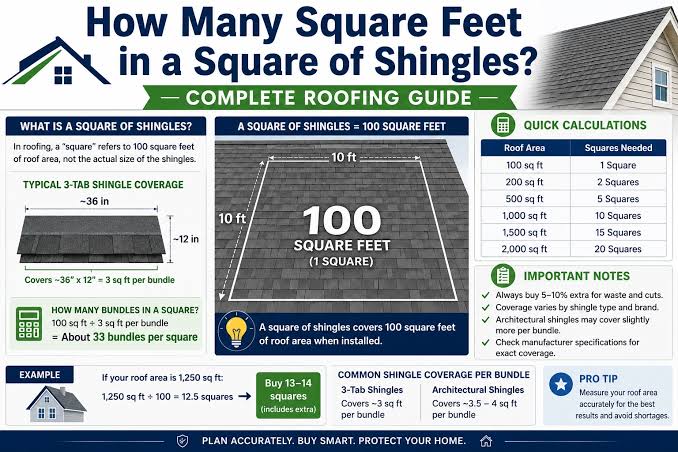
Comparison: Asphalt vs. Other Materials
To provide broader context, here is how asphalt shingles compare to other common roofing materials regarding coverage per package.
| Material Type | Approx. Coverage Per Bundle/Pkg | Bundles Per Square | Notes |
|---|---|---|---|
| Standard Asphalt | 33.3 sq ft | 3 | Most common residential choice. |
| Premium Asphalt | 20–25 sq ft | 4–5 | Heavier, longer lifespan. |
| Wood Shakes | Varies widely | N/A | Often sold by square directly, not bundles. |
| Clay Tile | N/A | N/A | Sold by piece; ~14 tiles per sq ft. |
For more detailed historical context on roofing materials and standards, you can refer to Wikipedia’s entry on Roofing.
Common Mistakes When Buying Shingles
Even with the right math, errors occur. Here are the most frequent pitfalls:
- Ignoring the Ridge Cap: The peak of your roof requires special ridge cap shingles. These are often sold separately or require specific cutting patterns that increase waste. Ensure you have enough material for the ridges.
- Forgetting Starter Strips: The first row of shingles along the eaves needs to be cut or replaced with specialized starter strips. This adds to your material cost but is essential for wind resistance.
- Assuming Uniformity Across Brands: Not all “Architectural” shingles are packaged the same. Brand A might pack 3 bundles per square, while Brand B packs 4. Never assume; always verify.
- Neglecting Underlayment: While not shingles, you need synthetic underlayment or felt paper. A roll of underlayment typically covers 4 squares (400 sq ft), but check the label.
Expert Tip: The Importance of Batch Numbers
When buying how many square feet in a package of roofing shingles, pay attention to the batch or lot number printed on the wrapper.
Shingles are manufactured in large runs. Slight variations in color can occur between different production batches. If you buy 30 bundles today and 10 more next month, they might not match perfectly. Always buy all your shingles at once from the same batch to ensure uniform color across your entire roof.
FAQ Section
Q1: Can I return unused bundles of shingles?
Most big-box home improvement stores allow returns of unused, unopened bundles within a specific timeframe (usually 90 days). However, specialty roofing suppliers may have stricter policies. Always keep your receipt and ask about the return policy before purchasing. Note that you usually cannot return partial bundles.
Q2: Does wind affect how many shingles I need?
Wind does not change the square footage calculation, but it influences the type of shingle and installation method. In high-wind zones, you may need to use more nails per shingle (6 instead of 4) and potentially use adhesive strips more aggressively. This doesn’t increase the number of bundles, but it increases labor time.
Q3: How much does a bundle of shingles weigh?
A standard bundle of asphalt shingles weighs between 50 and 80 pounds. Premium architectural shingles can weigh up to 100 pounds per bundle. This is important for logistics—ensure your vehicle can handle the load and that you have help lifting them onto the roof.
Q4: What is the difference between 3-tab and architectural shingles?
3-tab shingles are flat, single-layer, and lighter. They are cheaper but have a shorter lifespan (15–20 years). Architectural shingles are multi-layered, giving a dimensional look. They are heavier, more durable, and last longer (25–30+ years). Architectural shingles often require more bundles per square due to their thickness.
Q5: Do I need to account for overlap in my calculations?
No. The manufacturer’s stated coverage (e.g., 33.3 sq ft per bundle) already accounts for the necessary overlap. Shingles are designed to be installed with a specific exposure (usually 5 inches for standard shingles). As long as you follow the manufacturer’s installation guidelines, the coverage math holds true.
Q6: How do I measure a roof with multiple slopes?
Break the roof down into simple geometric shapes (rectangles, triangles). Measure each shape individually. For triangular sections (like gables), use the formula: (Base×Height)/2. Sum all areas together for your total square footage.
Conclusion
Understanding how many square feet in a package of roofing shingles is the foundation of a successful roofing project. Remember the golden rule: 3 bundles typically equal 100 square feet, meaning each bundle covers roughly 33.3 square feet. However, always verify this on the packaging, especially for premium or heavy-weight products.
By accurately measuring your roof, adding a 10–15% waste factor, and converting your total square footage into bundles, you can avoid the stress of mid-project supply runs. Roofing is an investment in your home’s safety and curb appeal, so taking the time to get the numbers right pays off in both durability and aesthetics.
If you found this guide helpful, please share it with your neighbors or friends who might be planning their own home improvements. Accurate information saves money and reduces waste!
Leave a Reply