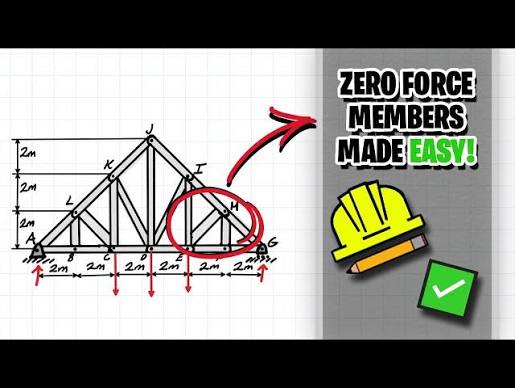
Are you staring at a complex web of lines in your structural analysis textbook, wondering which bars actually carry weight and which are just there for stability? It is a common frustration for engineering students and junior designers alike. Knowing how to determine the zero force members in the Pratt roof truss can cut your calculation time in half and give you a deeper intuitive understanding of structural behavior.
In this guide, we will break down the logic behind zero-force members (ZFMs). We won’t just give you formulas; we will teach you the visual “inspection method” that professionals use to identify these members instantly. By the end of this article, you will be able to look at a Pratt truss and confidently cross out the non-load-bearing elements before you even write down your first equilibrium equation.
What Are Zero-Force Members and Why Do They Matter?
Before we dive into the specific geometry of the Pratt truss, let’s define what we are looking for. A zero-force member is a structural component within a truss that carries no internal axial force under a specific loading condition.
You might ask, “If they carry no load, why are they there?” This is a critical question. While they may not carry load in an idealized theoretical model, in the real world, these members provide:
- Stability: They prevent long compression members from buckling.
- Redundancy: If the loading pattern changes (e.g., wind blows from a different direction), a zero-force member might suddenly become active.
- Construction Support: They help maintain the shape of the truss during assembly.
However, for the purpose of static analysis, identifying them allows you to simplify the free-body diagram significantly. Instead of solving for 15 unknown forces, you might only need to solve for 10.
The Two Golden Rules of Inspection
To determine the zero force members in the Pratt roof truss, you do not always need to perform the Method of Joints or the Method of Sections. You can use two simple rules based on the equilibrium of forces (∑Fx=0 and ∑Fy=0).
Rule 1: The Two-Member Joint
If a joint connects only two non-collinear members and there are no external loads or support reactions applied to that joint, then both members are zero-force members.
- Logic: For the joint to remain stationary, the forces in the two members must balance each other. Since they are not collinear (not in a straight line), the only way their vector sum can be zero is if the magnitude of the force in both is zero.
Rule 2: The Three-Member Joint
If a joint connects three members, where two are collinear (forming a straight line) and the third is not, and there is no external load at that joint, then the third (non-collinear) member is a zero-force member.
- Logic: Summing forces perpendicular to the collinear axis reveals that the non-collinear member has no opposing force to balance it. Therefore, its force must be zero.
Pro Tip: Always check for external loads first. If a load is applied directly to a joint, Rule 1 and Rule 2 generally do not apply immediately, as the external force disrupts the zero-sum condition.
Step-by-Step: Analyzing the Pratt Roof Truss
The Pratt truss is characterized by its diagonal members that slope downward toward the center. This configuration puts the longer diagonal members in tension and the shorter vertical members in compression under gravity loads. This is efficient because steel handles tension well, and short columns handle compression without buckling easily.
Let’s walk through how to determine the zero force members in the Pratt roof truss using a standard symmetric loading scenario (gravity loads applied only at the top chord joints).
Step 1: Identify the Loading Conditions
Assume a standard simply supported Pratt truss with pin support at one end and roller support at the other. Loads are applied vertically at the upper chord panel points.
Step 2: Inspect the Supports
Look at the supports. Usually, there are reaction forces here. Do not apply the zero-force rules blindly at the supports unless you have already calculated the reactions and know they don’t align with specific members in a way that creates a zero-force scenario (which is rare in standard Pratt trusses).
Step 3: Scan the Unloaded Joints
Move to the joints where no external load is applied. In a typical roof truss, loads are often applied at the top chord. The bottom chord joints are typically unloaded.
Let’s look at a specific joint on the bottom chord of a Pratt truss:
- Imagine a bottom chord joint connecting a left horizontal member, a right horizontal member, and a vertical web member.
- The two horizontal members are collinear.
- The vertical member is non-collinear.
- Is there an external load at this bottom joint? No.
- Conclusion: According to Rule 2, the vertical member connected to this unloaded bottom joint is a zero-force member.
Step 4: Propagate the Logic
Once you identify a vertical member as a zero-force member, look at the joint at the other end of that vertical member (on the top chord).
- If that vertical member has zero force, it effectively disappears from the analysis of the top joint.
- Now, inspect the top joint. Does it now consist of only two non-collinear members with no external load?
- If yes, those remaining members might also be zero-force, or it may simplify the geometry enough to apply Rule 1 or 2 again.
Note: In a standard Pratt truss with gravity loads on all top chords, the verticals connected to the unloaded bottom chords are the primary candidates for zero-force status. However, this depends heavily on whether the load is applied at every panel point.
Common Mistakes When Identifying ZFMs
Even experienced students make errors when trying to determine the zero force members in the Pratt roof truss. Here is a comparison of correct vs. incorrect thinking.
| Scenario | Incorrect Assumption | Correct Analysis |
|---|---|---|
| Joint with External Load | “It looks like Rule 2, so the vertical is zero.” | Stop! An external load breaks the symmetry. The vertical member must carry part of that load. |
| Symmetry | “The truss is symmetric, so all inner members are zero.” | Symmetry helps calculate reactions, but it does not automatically make internal members zero. Check joint equilibrium. |
| Diagonal Members | “Diagonals are always in tension, never zero.” | Diagonals can be zero if the loading pattern is unusual (e.g., specific point loads that bypass them). |
For a deeper mathematical understanding of truss stability and determinacy, you can refer to the general principles outlined on Wikipedia’s Truss page.
Why the Pratt Configuration is Unique
When you determine the zero force members in the Pratt roof truss, it is helpful to understand why this design is popular. Unlike the Howe truss (where diagonals slope upward toward the center), the Pratt truss places diagonals in tension.
In many standard loading cases for Pratt trusses:
- Verticals: Often carry compression. Some may be zero-force if the bottom chord joints are unloaded.
- Diagonals: Carry tension. It is rare for diagonals to be zero-force in a fully loaded Pratt truss unless the load path is very specific.
This distinction is vital. If you assume a diagonal is a zero-force member incorrectly, you might underestimate the tension requirements for the steel cables or rods used in that position.
FAQ Section
1. Can a zero-force member become load-bearing later?
Yes. Zero-force members are identified based on a specific loading condition. If the wind direction changes, or if a live load (like snow) accumulates unevenly, a member that was previously “zero” may suddenly carry significant stress. This is why they are never removed from actual structures.
2. Do I need to calculate reactions before finding zero-force members?
Not always. If you are using the inspection method (Rules 1 and 2) on joints that are far away from the supports and have no external loads, you can identify ZFMs without knowing the support reactions. However, for joints near supports, calculating reactions first is safer.
3. Are zero-force members present in all trusses?
No. Their presence depends on the geometry and the loading. A Warren truss, for example, has different zero-force characteristics compared to a Pratt truss. Always analyze the specific joint conditions.
4. What happens if I ignore a zero-force member in my calculation?
If you correctly identify it as zero, ignoring it simplifies the math. If you incorrectly ignore a member that is not zero, your entire analysis will be wrong, leading to potential structural failure in design scenarios. Always double-check using ∑Fy=0.
5. How does this help in real-world construction?
Identifying these members helps engineers optimize material usage. While we keep them for stability, knowing they carry minimal load allows us to use lighter gauge materials for those specific bars, reducing cost and weight without compromising safety.
Conclusion
Learning to determine the zero force members in the Pratt roof truss is a fundamental skill that bridges the gap between theoretical statics and practical engineering intuition. By mastering the two inspection rules—checking for unloaded two-member joints and unloaded three-member joints with two collinear bars—you can streamline your analysis process significantly.
Remember, while these members may carry “zero” force in your textbook problems, they play a vital role in the real-world stability and buckling resistance of the structure.
Did this guide help clarify the concept for you? If you found this tutorial useful, please share it with your study group or on LinkedIn to help fellow engineering students master structural analysis!